
Block Making Machine in Pakistan – High-Quality Models by Silver Steel Mills
Block Machine Hydraulic System & Wiring Guide – Complete Technical Manual for SSM Series (Silver Steel Mills)
Introduction – Why Proper Wiring Matters for Your Block Machine
A block making machine is a complex assembly of hydraulic systems, electric motors, sensors, and a central controller. Incorrect wiring can lead to:
-
Motor damage (burning out due to reverse rotation)
-
Hydraulic system failure (pressure losses, leaks)
-
Sensor misreading (incorrect mould position, material flow errors)
-
Production downtime (costing you thousands of rupees per hour)
At Silver Steel Mills, we don’t just manufacture SSM series block machines (SSM 15, 18, 24, 35, 50). We also provide complete on‑site installation, wiring, and training to ensure your plant operates at peak efficiency.
This technical guide is based on our actual field installation procedures – the same steps our engineers follow when setting up machines for clients like Nishat Power, CSCEC (CPEC Motorway), DHA Multan, and Gulberg Greens Islamabad.
⚠️ Safety Warning: Electrical and hydraulic work should only be performed by trained professionals. The following guide is for reference and training purposes. Always isolate power before handling wires.
Part 1: Understanding Your Block Machine’s Key Components
Before connecting any wires, identify the main components of your SSM block machine:
| Component | Function | Typical Location |
|---|---|---|
| Hydraulic Power Pack | Provides hydraulic pressure (150‑300 tons) for pressing | Beside the main machine |
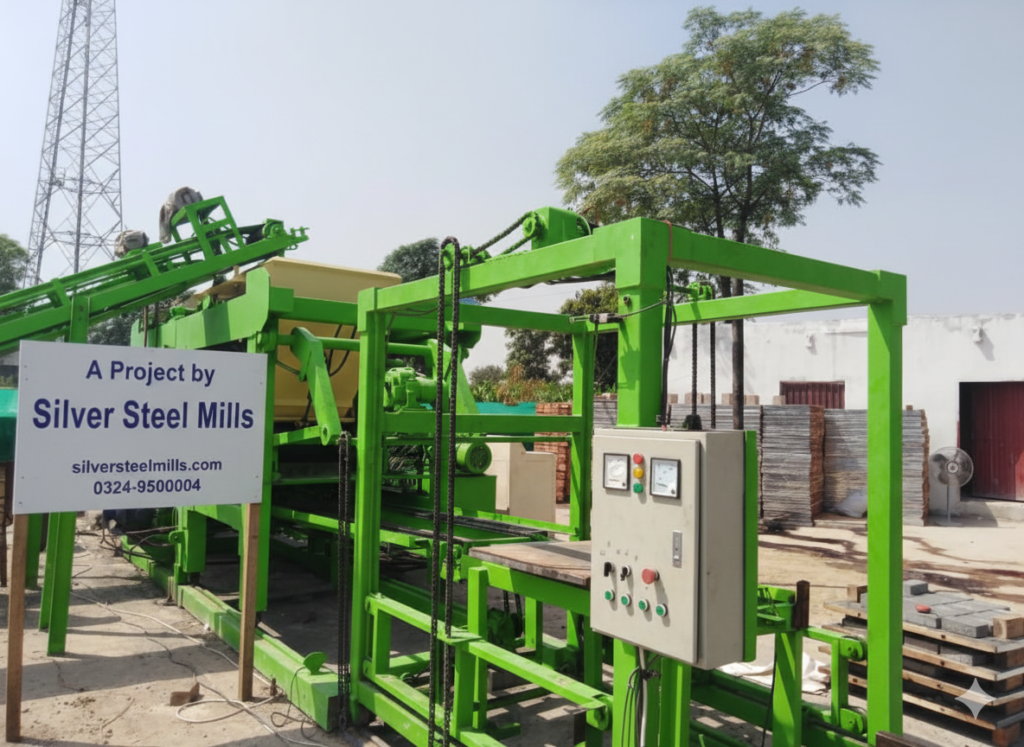
| Controller Box (PLC / Digital Panel) | Brain of the machine – controls cycles, sensors, motors | Mounted on a stand or wall |
| Electric Motors (4 main types) | Vibration, material feeding, conveyor, hydraulic pump | On or near the machine frame |
| Sensors (limit switches / proximity) | Detect mould position, pallet presence, material level | On mould box, feeder, conveyor |
| Keyboard / Control Panel | User interface for manual operation | Attached to controller box |
Our SSM machines have four primary electric motors:
-
Two vibration motors (under the mould box) – generate high‑frequency vibration.
-
One material feeding motor (agitator) – pushes mix into the mould.
-
One conveyor / feeder motor – moves raw material from hopper to mould.
Plus a hydraulic pump motor (located on the hydraulic tank).
Part 2: Hydraulic System Connections – Direction Matters
2.1 Identifying Hydraulic Hoses
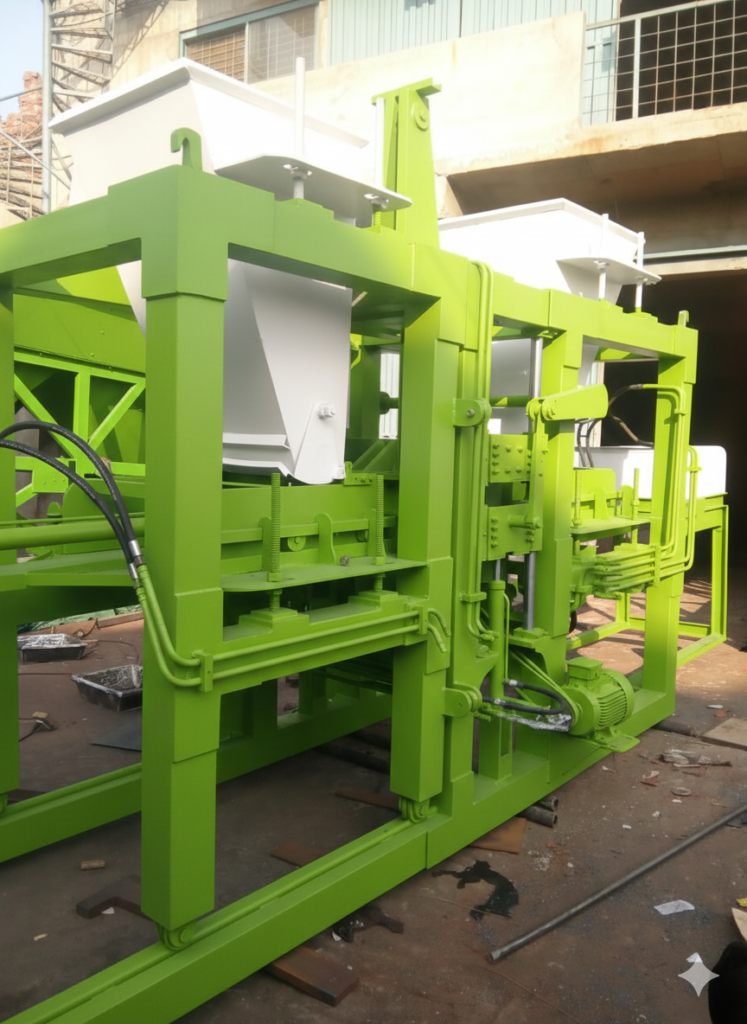
The hydraulic system has two main hoses connecting the power pack to the main cylinder:
| Hose Type | Characteristic | Correct Connection |
|---|---|---|
| High‑pressure line | Thicker, often with steel braiding | Connect to the right‑side port (when facing the cylinder) |
| Return line | Thinner, flexible rubber | Connect to the left‑side port |
Critical Rule: The wider (larger diameter) hose goes to the right side of the cylinder. The narrower hose goes to the left side. Reversing these will prevent the mould from lifting or pressing properly.
2.2 Checking Hydraulic Oil Level
Before first start, fill the hydraulic tank with 800 litres (for SSM 35) or 400 litres (for SSM 15/18) of ISO VG 46 or 68 hydraulic oil. Use a dipstick or sight glass to verify level. Low oil causes cavitation and pump damage.
2.3 Tightening Fittings
After connecting hoses, use a torque wrench to tighten all fittings to 20‑25 Nm (for 1/2″ BSP). Do not over‑tighten – you may crack the fitting.
Part 3: Wiring the Electric Motors – Step by Step
All SSM machines use 3‑phase, 380‑415V AC motors. Each motor has a terminal box with three wires (usually red, yellow, green – or U, V, W). The controller box has corresponding output terminals (labelled M1, M2, M3, etc.).
3.1 Identifying the Four Motors
On a typical SSM block machine:
| Motor Label | Function | Terminal Box Location |
|---|---|---|
| M1 | Vibration motor (left side) | Under mould box, left |
| M2 | Vibration motor (right side) | Under mould box, right |
| M3 | Material feeding (agitator) | On hopper / feeder chute |
| M4 | Conveyor / transfer motor | Under the conveyor belt |
Additionally, the hydraulic pump motor (labelled M5 or P) is on the hydraulic tank.
3.2 Connecting Wires
-
Run cables from each motor to the controller box. Use flexible, oil‑resistant cable (4‑core, 4‑6 mm²).
-
Match wire colours – connect each motor’s three wires to the corresponding terminals in the controller box (e.g., M1‑1, M1‑2, M1‑3).
-
Secure the connections with cable lugs and tighten screws.
Important: Do not worry about direction yet. We will test and reverse any motor that spins incorrectly.
3.3 Testing Motor Rotation Direction
After all wires are connected, power on the machine and briefly jog each motor (press start for 1 second, then stop).
For Vibration Motors (M1 and M2):
-
Correct: The two motors must rotate in opposite directions (one clockwise, the other counter‑clockwise). This creates a balanced, high‑amplitude vibration.
-
Incorrect: If both rotate the same direction, the mould will shake sideways and damage the machine.
For the Material Feeding Motor (M3):
-
Correct: Rotates such that the agitator pushes material towards the mould cavity.
-
Incorrect: Material moves away – production stops.
For the Conveyor Motor (M4):
-
Correct: Belt moves towards the mould hopper.
-
Incorrect: Belt moves backwards, material spills.
For the Hydraulic Pump Motor (M5):
-
Correct: Pump rotates clockwise (when viewed from the fan end). Check the arrow on the pump housing.
-
Incorrect: Pump runs dry – can seize within minutes.
3.4 Changing Rotation Direction
To reverse a 3‑phase motor, swap any two of the three wires at the motor terminal box or the controller output. For example, if the motor has wires U, V, W connected to terminals 1, 2, 3, swap V and W (connect U→1, W→2, V→3).
Repeat the test until all motors rotate correctly.
Part 4: Sensor Connections – Limit Switches and Proximity Sensors
Your SSM block machine uses inductive proximity sensors (or micro switches) to detect:
-
Mould top position (when the mould box lifts fully)
-
Mould bottom position (after pressing)
-
Material cut front/back position (feeder movement)
-
Pallet feeder position (for automatic stacking)
Each sensor has three wires:
| Wire Colour | Function | Connection |
|---|---|---|
| Brown | Positive supply (+24V DC) | Connect to V+ terminal |
| Blue | Negative (ground) | Connect to V‑ (common) |
| Black | Signal (output) | Connect to the specific X input (e.g., X0, X1, X2…) |
4.1 Identifying Sensor Locations and Inputs
From our field installation notes (based on the video transcript):
| Sensor Function | Location | Input Terminal (Black wire) | Notes |
|---|---|---|---|
| Mould top limit | Top of mould box guide | X0 | Stops upward movement |
| Mould bottom limit | Bottom of mould box guide | X1 | Stops downward movement |
| Mould box top limit | Mode box top | X2 | Secondary limit for mould box |
| Mould box bottom limit | Mode box bottom | X3 | Secondary bottom limit |
| Material cut – front limit | Front of feeder | X4 | Feeder forward end |
| Material cut – back limit | Back of feeder | X5 | Feeder return end |
| Pallet feeder front limit | Pallet feeder forward | X6 | For automatic pallet stacker |
| Pallet feeder back limit | Pallet feeder return | X7 | – |
| Caliper material feeding front | For optional caliper system | X24 | Only if installed |
| Caliper material feeding back | For optional caliper system | X25 | Only if installed |
Pro tip: Write these labels on masking tape and stick them next to each sensor for easy maintenance.
4.2 Wiring Procedure
-
Connect the black wire of each sensor to its assigned X input (e.g., mould top limit black wire to X0).
-
Connect all brown wires from all sensors together, then connect to the V+ (24V supply) terminal in the controller box.
-
Connect all blue wires from all sensors together, then connect to the V‑ (common / ground) terminal.
4.3 Testing Sensors
After wiring, power on the controller and manually trigger each sensor (e.g., move the mould up by hand until the limit switch clicks). The corresponding input LED on the PLC or controller should light up. If not:
-
Check the black wire connection.
-
Verify 24V supply between brown and blue (use a multimeter).
-
Replace the sensor if defective.
Part 5: Controller Box – Final Integration and Cover Installation
The controller box houses the PLC (or digital board), relays, and terminal strips. After all hydraulic hoses, motor cables, and sensor wires are connected:
-
Organize wires using cable ties – keep low‑voltage (sensor) wires away from high‑voltage (motor) wires to prevent interference.
-
Close the controller box cover securely to protect against dust and moisture.
-
Label the outside with the machine model (SSM 15/18/24/35/50) and date of installation.
Part 6: First Test Run – What to Check
Before full production, run a dry cycle (without concrete mix):
-
Start hydraulic pump – listen for unusual noise (knocking indicates air in the system – bleed it).
-
Jog each motor again to confirm direction.
-
Perform a full automatic cycle using the keyboard/PLC:
-
Feeder forward → material drop → vibration → hydraulic press → mould lift → feeder return → pallet advance.
-
-
Observe sensors – the cycle should stop immediately if a limit is reached.
If any step fails, double‑check the corresponding sensor or motor wiring.
Silver Steel Mills – Your Partner Beyond the Machine
Installing and wiring a block making machine is a technical task that requires experience. Silver Steel Mills offers:
-
On‑site commissioning – our engineers travel to your location anywhere in Pakistan.
-
Operator training – 2‑week hands‑on training for your staff, including wiring basics, troubleshooting, and maintenance.
-
After‑sales support – 3 months free service, with spare parts (sensors, cables, hydraulic seals) available from our Gujranwala factory.
-
Remote phone support – call us if you face any electrical or hydraulic issue.
“When we installed the SSM 18 for CSCEC on the CPEC motorway, our team spent a full day wiring and testing the entire plant. The CSCEC engineers later told us that our wiring diagram was the most detailed they had ever seen.” – Silver Steel Mills Senior Technician
Frequently Asked Questions (FAQ) – Wiring & Installation
Q1: Can I use any electric cable for the motors?
A: Use 4‑core, 4‑6 mm² copper flexible cable (PVC insulated, oil‑resistant). Avoid aluminium wires – they overheat.
Q2: What happens if I reverse the two vibration motors?
A: They will both spin the same direction, cancelling out vibration. The blocks will be weak and uneven. Immediately swap two wires on one motor.
Q3: How do I know if a proximity sensor is working?
A: Bring a metal object (like a screwdriver) close to the sensor face. The LED on the sensor should light up, and the corresponding input on the controller should turn ON.
Q4: The hydraulic pump makes a loud grinding noise. Why?
A: Air in the system. Check oil level – it may be low. Run the pump for 5‑10 minutes with the pressure valve open to bleed air.
Q5: My mould won’t lift after pressing. Which sensor should I check?
A: The mould bottom limit (X1). If this sensor stays active, the PLC thinks the mould is already down and won’t lift. Clean or replace the sensor.
Conclusion – Master Your Block Machine with Silver Steel Mills
Proper wiring of the hydraulic system, motors, and sensors is essential for safe, efficient block production. This guide gives you the knowledge to install and troubleshoot your SSM series block machine. However, for best results, we always recommend having our certified technicians handle the initial installation and training.
Silver Steel Mills – Pakistan’s leading manufacturer of SSM block machines (15, 18, 24, 35, 50) for fly ash bricks, pavers, hollow blocks, and curbstones. From Nishat Power to CPEC motorway, from DHA Multan to Gulberg Greens, our machines are trusted by industry leaders.
1. What Can a Block Making Machine Produce?
Modern automated block machines are highly versatile. By switching the heavy-duty die moulds, a single machine can manufacture a diverse array of structural and decorative products:
-
Fly Ash Bricks: Utilizing industrial waste (fly ash or biomass ash) mixed with sand, lime, or cement to construct high-density, perfectly uniform building bricks.
-
Hollow Blocks: Commonly utilized in commercial and boundary walls, these units provide excellent thermal and acoustic insulation while reducing structure dead weight.
-
Solid Concrete Blocks: Heavy-load-bearing masonry units crucial for structural foundations and load-bearing walls.
-
Tuff Tiles / Interlocking Pavers: High-PSI pavers (ranging from 6,000 to 7,000+ PSI) available in rectangular, zig-zag, or hexagonal configurations, used extensively for streets, gas stations, and parking lots.
-
Kerbstones / Curbstones: Solid, elongated perimeter blocks used globally to delineate road shoulders, footpaths, and highway medians.
2. Essential Raw Materials and the Production Recipe
To produce premium, commercial-grade bricks and blocks that satisfy international engineering standards, specific raw material blending is essential:
-
Fly Ash / Biomass Ash: Acting as a sustainable pozzolanic binder, fly ash reacts chemically with calcium hydroxide to elevate the long-term durability of the unit.
-
Sand: Finely graded river sand or pit sand functions as a vital structural aggregate filler.
-
Crush / Aggregate Dust (0mm to 5mm): Fine crushed stone dust or small aggregate chips provide structural strength and concrete density.
-
Portland Cement: Functions as the primary chemical adhesive binder holding the aggregate formulation together.
-
Water: Regulated carefully during digital batching to trigger cement hydration without making the mix overly wet.
3. Engineering Specifications of Silver Steel Mills Machinery
Silver Steel Mills (SSM) manufactures an extensive portfolio of concrete block-making plants in Pakistan, ranging from entry-level single-trolley machines to massive automated batching industrial plants. Below is an extensive technical breakdown of their flagship commercial models:
Model 1: SSM 15 Single Portion Plant
Designed for small-to-medium enterprises entering the block manufacturing business.
-
System Configuration: Auto pallet with a single-trolley delivery design.
-
Production Velocity: Outputs 100 to 110 pallets per hour.
-
Pallet Capacity: Accommodates 15 rectangular pavers or 6 standard blocks per cycle.
-
Molding Cycle Duration: 25 to 35 seconds per compression stroke.
-
Electrical Power Load: 63 HP total capacity usage (including 20 HP vibration, 20 HP hydraulic pump, and 20 HP mixer machine motors).
-
Pallet Footprint: Uses 650mm × 750mm × 28mm wooden pallets.
Model 2: SSM 18 Brick Unified Plant
Optimized specifically for high-volume biomass and industrial fly ash brick projects.
-
System Configuration: Single portion platform engineered with premium SS400 chrome shafts and heavy-duty Q235 MS imported sheet steel structures.
-
Hydraulic Pumping Force: Outfitted with an extraordinary 21-gallon dual pump delivering up to 10,000 PSI of working pressure along with an integrated hydraulic oil cooling radiator system.
-
Pallet Capacity: Holds 18 interlocking tiles or 15 high-density bricks per compression cycle.
-
Raw Material Storage: Outfitted with a special extra-large aggregate storage hopper with a chrome-shafted hydraulic discharging door.
-
Material Conveyance: Features a 30-foot heavy-duty aggregate belt conveyor paired with an 8-foot automated pallet transport chain conveyor driven by a 3 HP gear motor.
Model 3: SSM 24 Double Layer Plant with Batching System
An advanced choice for producing dual-layer premium tuff tiles with a top colored pigment finish.
-
System Configuration: Fully automatic double-layer plant incorporating dedicated aggregate and pigment hoppers.
-
Electrical Power Load: Consumes 135 HP total capacity usage (30 HP hydraulic pump, 40 HP dual vibration motors, 40 HP combined mixer drives, and 15 HP stacker/conveyor systems).
-
Hydraulic Capacity: Requires a 600-liter hydraulic oil reservoir complemented by 50 liters of industrial gear oil.
-
Pallet Footprint: Utilizes a 30″ × 42″ heavy wooden pallet configuration.
Model 4: SSM 35 Fully Automatic Batching Plant
A premium high-output industrial system utilizing automated digital batching networks.
-
System Configuration: Auto pallet paired with an efficient double-trolley delivery matrix.
-
Production Velocity: Alternates between 80 to 100 pallets per operational hour.
-
Pallet Capacity: Compresses 35 rectangular paver units per stroke.
-
Daily Structural Output: Capable of generating up to 24,000 premium bricks or blocks in a single standard shift.
-
Electrical Power Load: Operates on a 131 HP power grid layout (40 HP vibration, 30 HP hydraulic, 40 HP mixer, 11 HP conveyor, and 10 HP automated stacker systems).
-
Molding Cycle Duration: Fast cycle times ranging from 20 to 30 seconds.
Model 5: SSM 50 Industrial Flagship Plant
The highest-capacity production system manufactured by SSM for mega infrastructure projects.
-
System Configuration: Premium double-trolley automated layout utilizing full digital batching, weighing scales, and PLC touch panels.
-
Production Velocity: Sustains 80 to 100 large-format pallets hourly.
-
Pallet Capacity: Accommodates 50 rectangular pavers or 36 metric standard bricks (dimensions: 228mm × 110mm × 76mm) per compression cycle.
-
Daily Structural Output: Easily delivers an impressive 40,000 interlocking pavers or bricks per shift.
-
Electrical Power Load: Engineered for a 161 HP industrial load, backed by heavy-duty 60 HP dual-vibration motors and a 40 HP hydraulic pump system.
-
Hydraulic Capacity: Requires an 800-liter hydraulic oil reservoir to manage heavy continuous production cycles.
4. The Plant Site Layout and Workflow Blueprint
Setting up a professional concrete block plant requires strategic spatial planning. Below is an architectural blueprint demonstrating how raw materials transition into finished, cured products:
[ Raw Material Storage ] -------> [ Digital Batching Plant ]
 (Sand, Crush, Fly Ash)             (Weighs Materials Accurately)
                                                |
                                                v
[ Finished Product Stacking ] <--- [ Hydraulic Compression ] <--- [ Twin Shaft Mixer ]
 (Curing Yards & Shipping)          (Moulds & Shakes Blocks)       (Water & Cement Mix)
-
The Feeding Zone: Front-end wheel loaders dump sand, crush stone, and fly ash into individual compartments of the digital aggregate batching plant.
-
The Mixing Zone: The automated batching system weighs the ingredients precisely before discharging them into a high-intensity twin-shaft mixer, where cement and water are added.
-
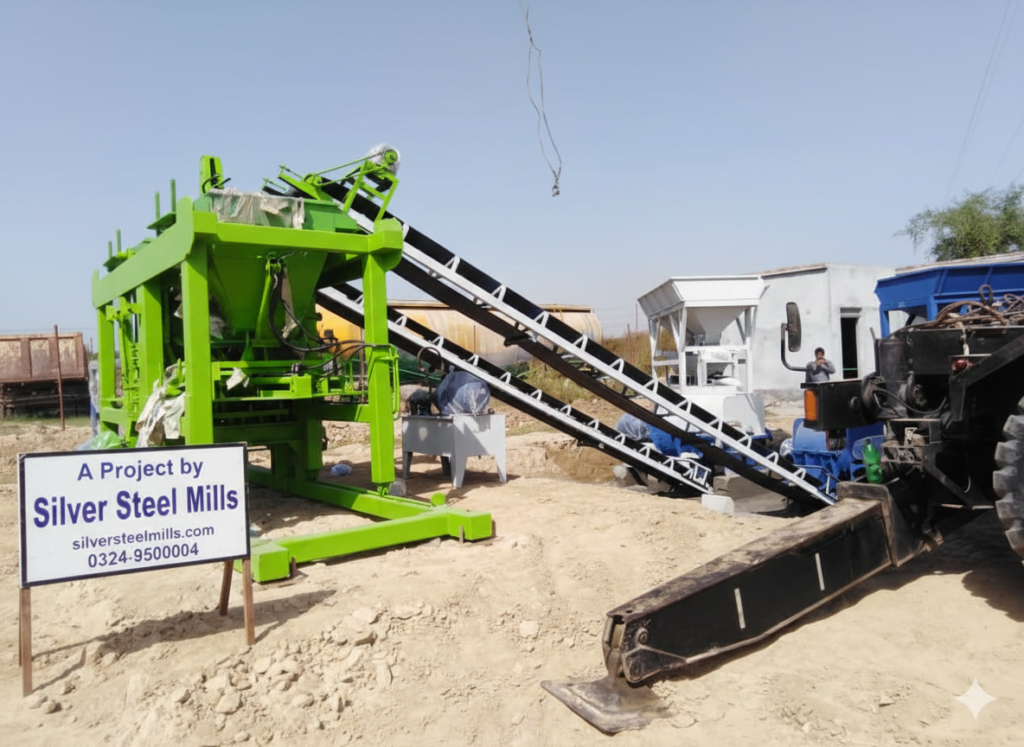
The Molding Zone: The wet concrete mix travels via an overhead conveyor belt into the machine’s primary storage hopper. It fills the precision CNC-engraved steel die mould.
-
The Compression Stage: A combination of intense hydraulic downward pressure (up to 10,000 PSI) and vertical table vibration compacts the mix, solidifying it into blocks within seconds.
-
The Stacking & Curing Stage: The automated pallet stacker lifts and organizes the fresh wet blocks. Forklifts or loaders then transport them to a dedicated curing yard, where they are misted with water for 7 to 14 days to reach peak structural strength.
5. Cost-Benefit Analysis: Why Investing in Automatic Block Machines is Highly Lucrative
Shifting from primitive brick kilns to high-tech automated block production offers compelling financial returns.
Faster Payback Periods
According to industry feasibility studies for mid-tier machinery like the SSM 35, a well-managed plant can produce substantial monthly returns. For example, a factory operating at standard capacity can generate substantial monthly revenue, yielding an average capital payback period of just 15 months. This makes it one of the most secure and fast-recovering investments in Pakistan’s industrial manufacturing sector.
Significant Environmental Compliance
Traditional brick kilns are frequently shut down by Environmental Protection Departments due to their reliance on coal and rubber combustion, which releases toxic black carbon smoke. In contrast, block-making machines use clean, hydraulic electricity, emit zero smoke, and actively repurpose industrial waste like fly ash—making them completely immune to environmental closures.
Superior Technical Advantages
-
Impeccable Structural Integrity: Machine-pressed units resist water absorption far better than clay bricks, preventing structural issues like saltpetre (shora) damage on plaster walls.
-
Perfect Dimensional Accuracy: Standardized machine blocks eliminate structural irregularities, cutting down masonry mortar consumption by up to 30%.
-
Reduced Labor Dependency: Fully automatic plants handle heavy-duty processes like aggregate batching and pallet stacking mechanically, lowering manual labor requirements and reducing human error.
Traditional clay bricks suffer from major dimensional variations, seasonal production halts due to winter smog, and high water absorption, which triggers structural damage (shora). Modern contractors and developers have shifted their focus completely toward automated concrete block making machines.
By processing locally available raw materials—including river sand, crushed stone aggregate, cement, and industrial waste like fly ash or biomass ash—these heavy-duty machines compress and vibrate high-density solid blocks, hollow insulation blocks, interlocking tuff tiles/pavers (capable of reaching 6,000 to 7,000+ PSI), and road curbstones with absolute geometric precision.
As the country’s premier engineering house for construction machinery, Silver Steel Mills (SSM) designs, fabricates, and installs fully integrated concrete brick and paver lines. Below is a detailed technical analysis of the official SSM industrial machinery lineup, based directly on certified factory blueprints and feasibility specifications.
Building the CPEC Backbone: A Story of Engineering Resilience
The CPEC (China-Pakistan Economic Corridor) is more than just a network of roads; it is the lifeline of Pakistan’s future infrastructure. Among the most challenging sections of this massive undertaking was the Multan-Sukkur Motorway (M-5). While the asphalt and bridges are often the focus, the silent heroes of this project are the millions of concrete blocks, tuff tiles, and kerbstones that line the interchanges, rest areas, and drainage systems of this high-speed arterial route.
This is a story of how an engineering crisis nearly halted a national mega-project, and how a local Pakistani manufacturer turned that crisis into a triumph of home-grown engineering.
The Crisis: When High-Tech Fails
When the China State Construction Engineering Corporation (CSCEC)—a global titan in construction—first arrived at the M-5 site, they came prepared. They imported high-tech, multi-million dollar machinery directly from China, expecting a seamless manufacturing process for the massive quantities of blocks and pavers required.
However, the reality of the construction site didn’t match the climate-controlled environment of a factory. The imported machinery struggled with local environmental factors, moisture levels in the sand, and the specific composition of local aggregates. Technical breakdowns became a daily occurrence. The “high-tech” systems were stalling, the production line was silent, and the clock on the Multan-Sukkur project was ticking.
The project was at risk of a major delay. The Chinese engineers were frustrated, and the dream of a seamless motorway handover felt like it was slipping away.
The Turning Point: Entering Silver Steel Mills (SSM)
In the middle of the frustration, the CSCEC leadership decided to look for a local solution. They reached out to Silver Steel Mills (SSM).
When our engineering team first arrived at the Jalalpur Pirwala, Hyderabad, and Sukkur units, we didn’t just see broken machines; we saw an engineering challenge. We analyzed why the imported plants were failing. It wasn’t about the power of the motors; it was about adaptation. The machines weren’t designed to handle the specific raw material variations of Pakistan’s soil and fly ash waste.
Our team went back to the drawing board. We didn’t just repair the old machines; we designed a specialized, custom-engineered block-making solution from the ground up, specifically for the harsh conditions of the CPEC site.
The Solution: Precision Built for Pakistan
We fabricated machines that were not just “industrial”—they were resilient. We implemented robust hydraulic systems, high-frequency vibration tables, and custom die moulds that could handle the local fly ash and concrete mix with precision.
The installation was a race against time. From Jalalpur Pirwala to Sukkur, our technicians worked side-by-side with the CSCEC team, commissioning the plants under the intense heat of the Pakistani summer.
The moment the first pallet of high-density tuff tiles rolled off the SSM-designed machine, the atmosphere changed. The blocks were perfect—consistent in size, high in compressive strength, and durable enough to withstand the load of heavy motor traffic for decades.
The Result: A Motorway Built on Reliability
The difference in production was night and day. The SSM machines ran continuously, hitting the targets that the imported machines couldn’t touch. We produced millions of blocks, pavers, and kerbstones that now define the M-5 motorway.
The Chinese engineers, initially skeptical of local solutions, were genuinely impressed. They were accustomed to global technology, but they hadn’t seen engineering that was so perfectly tailored to the project’s unique operational needs. They saw that the real secret to CPEC’s success wasn’t just bringing technology from abroad—it was localizing that technology to work in our backyard.
The Multan-Sukkur Motorway was completed on time. The client was delighted. For the team at Silver Steel Mills, that project was more than just a contract; it was the moment we proved that Pakistani engineering could stand toe-to-toe with the best in the world.
Lessons Learned: Why Local Expertise Matters
The success of the M-5 project taught us a valuable lesson: Construction machinery isn’t just about high-speed motors; it’s about compatibility with the site.
Today, Silver Steel Mills continues to supply plants to every corner of Pakistan—from Lahore and Faisalabad to Peshawar and Karachi. We use the same grit and engineering expertise that we brought to the CPEC project to empower local contractors and businessmen.
Whether you are building a small housing society or a massive national highway, the lesson remains the same: If you have a manufacturing problem, you need a local partner who understands the terrain.
Are you ready to build the future? At Silver Steel Mills, we don’t just sell machines; we provide the backbone for your construction dreams. Let us help you design your next production line with the same precision that built the backbone of CPEC.
Pakistan’s construction sector is expanding at a breakneck pace. From massive infrastructure ventures like CPEC highways and public transport corridors to high-rise commercial sectors and housing schemes, the demand for resilient building units is at an all-time high. Traditionally, old-school red clay brick kilns (bhatta) dominated the local market. However, due to severe environmental lockdowns over heavy smog, seasonal operational halts, and inconsistent quality, a massive structural shift toward automated block making machines is underway.
Modern machinery manufactures high-strength concrete elements efficiently using eco-friendly raw materials. Prominent local manufacturers, such as Silver Steel Mills (SSM), lead this industrial movement by providing heavy-duty, fully automatic concrete block and paver plants engineered tailored to Pakistan’s demanding conditions.
The Raw Material Recipe & Product Blueprint
To achieve premium, load-bearing quality that complies with international building codes, the automatic block machine utilizes a synchronized aggregate matrix:
-
Industrial Fly Ash / Biomass Ash: Acts as a highly reactive pozzolanic binder that improves the structural density, water resistance, and long-term lifespan of grey bricks.
-
Crushed Aggregate Dust (0mm to 5mm): Provides the structural bedrock and extreme interlocking mass required to reach high compressive strength thresholds.
-
River Sand: Acts as a fine aggregate filler to fill micro-voids, ensuring smooth product surfaces and sharp edges.
-
Portland Cement: The chemical adhesive that activates upon controlled moisture contact to secure the entire aggregate blend.
Official Silver Steel Mills (SSM) Machine Specifications
1. SSM 15 Auto Single-Portion Plant
An excellent entry-level solution designed for small-to-medium enterprises (SMEs), housing schemes, and localized masonry startups looking for a low capital layout.
-
Machine Operation System: Auto pallet and single-trolley delivery system.
-
Production Capacity: 100 to 110 pallets per hour.
-
Molding Cycle Speed: 25 to 35 seconds per compression stroke.
-
Pallet Product Capacity: Holds 15 Rectangular Pavers or 6 Standard Blocks per single pallet drop.
-
Wooden Pallet Dimensions: 650mm × 750mm × 28mm.
-
Supported Product Height: Flexible molding depth between 50mm to 200mm.
-
Total Electrical Power Grid Load: 63 HP
-
Vibration Motors: 20 HP ($10\text{ HP} \times 2$)
-
Hydraulic Pump Motor: 20 HP
-
Mixer Machine Motor: 20 HP
-
Conveyor Gear Motor: 3 HP
-
2. SSM 18 Brick Unified Plant (Biomass & Fly Ash Focus)
Specially engineered to handle the abrasive nature and volumetric demands of biomass ash and industrial fly ash material recipes.
-
Structural Composition: Manufactured using premium SS400 steel framing, solid SS chrome shafts, and Q235 MS imported sheet steel cores to resist continuous mechanical stress.
-
Extreme Hydraulic Compaction: Outfitted with an extraordinary 21-gallon dual pump assembly generating up to 10,000 PSI of crushing working pressure, backed by an integrated hydraulic oil cooling radiator system.
-
Die Mould Technology: Q235B high-grade imported hard flat bar steel shaped via precise CNC machining and top-punch engraving.
-
Pallet Product Capacity: Delivers 18 Interlocking Tiles or 15 High-Density Bricks per pallet drop.
-
Wooden Pallet Dimensions: 32 inches × 30 inches.
-
Material Conveyance Setup: Features an elongated 30-foot heavy-duty aggregate belt conveyor and an 8-foot automatic chain transport conveyor driven by a 3 HP gear motor.
-
Total Electrical Power Grid Load: 63 HP (Balanced across a 20 HP hydraulic pump, 20 HP high-amplitude vibrators, and a 20 HP compulsory mixer).
3. SSM 24 Double-Layer Plant (With Batching System)
The industrial standard for manufacturing premium, dual-layer interlocking tuff tiles with a vibrant, high-wear colored pigment top-coat.
-
Machine Operation System: Fully automatic, double-layer design featuring independent dual portion systems (one for the main grey concrete base, one for the colored pigment face).
-
Hydraulic Assembly: Heavy-duty imported lever control valves paired with a high-capacity hydraulic oil reservoir.
-
Pallet Product Capacity: Holds 24 Bricks or Interlocking Pavers per single drop cycle.
-
Wooden Pallet Dimensions: 30 inches × 42 inches.
-
Fluid & Operating Requirements: Requires a 600-liter hydraulic oil charge and 50 liters of industrial gear oil.
-
Total Electrical Power Grid Load: 135 HP
-
Hydraulic Pump Motor: 30 HP
-
Vibration Table Motors: 40 HP ($20\text{ HP} \times 2$)
-
Mixer Machine Motors: 40 HP (30 HP Main Mixer + 10 HP Pigment Mixer)
-
Stacker & Conveyor System: 15 HP (Distributed across 5 HP, 2 HP, 3 HP, 2 HP, and 3 HP gear drives)
-
Batching Hopper Conveyor: 10 HP
-
4. SSM 35 Fully Automatic Double-Trolley Plant
A high-output commercial production center utilizing automated digital batching systems to achieve major output targets.
-
Machine Operation System: Auto pallet and synchronized double-trolley raw material delivery system.
-
Production Capacity: 80 to 100 pallets per hour.
-
Molding Cycle Speed: 20 to 30 seconds per cycle.
-
Pallet Product Capacity: Compresses 35 Rectangular Pavers or 35 Tuff Tiles per single stroke.
-
Daily Production Yield: Generates an impressive 24,000 Premium Bricks/Blocks per standard 8-hour operational shift.
-
Supported Product Height: 50mm to 200mm.
-
Fluid Requirements: Requires an 800-liter industrial hydraulic oil reservoir.
-
Total Electrical Power Grid Load: 131 HP
-
Vibration Table Motors: 40 HP ($20\text{ HP} \times 2$)
-
Hydraulic Pump Motor: 30 HP
-
Dual Mixer Motors: 40 HP (Combined 10 kW + 30 kW setup)
-
Material Conveyors: 11 HP (3 HP + 3 HP + 3 HP + 5 HP)
-
Automated Product Stacker: 10 HP (5 HP + 3 HP + 2 HP)
-
5. SSM 50 Industrial Flagship Plant
The ultimate, high-capacity powerhouse manufactured by Silver Steel Mills for national mega-projects, CPEC works, and major commercial ready-mix suppliers.
-
Machine Operation System: Premium fully automated double-trolley layout utilizing full digital PLC touch-screen operating systems and automatic load-cell weighing scales.
-
Production Capacity: 80 to 100 heavy-format pallets per hour.
-
Molding Cycle Speed: Fast-acting 20 to 30 second compression and shake intervals.
-
Pallet Product Capacity: Drops 50 Rectangular Pavers or 36 Standard Concrete Bricks (Dimensions: 228mm × 110mm × 76mm) per single machine stroke.
-
Daily Production Yield: Delivers up to 40,000 Interlocking Pavers or Bricks in a single standard shift.
-
Fluid Requirements: Large-scale 800-liter hydraulic oil tank complete with an integrated forced-chiller cooling radiator system.
-
Total Electrical Power Grid Load: 161 HP
-
Vibration Table Motors: 60 HP ($30\text{ HP} \times 2$ deep-penetration vibration core)
-
Hydraulic Pump Motor: 40 HP
-
Industrial Mixer Drive: 40 HP (10 kW + 30 kW compulsory configuration)
-
Material Conveyors: 11 HP
-
Heavy-Duty Stacker Unit: 10 HP
-
Operational Workflow of a Turnkey Automatic Plant
To maintain high production speeds without bottlenecking, an SSM plant integrates several stages into a single continuous loop:
  [ AUTOMATED BATCHING HOPPERS ] ──> [ REINFORCED CONVEYOR ] ──> [ COMPULSORY MIXER CORE ]
                                                                             │
  [ AUTOMATED CURED STACKING ]   <── [ HYDRAULIC PRESS / MOLD ]  <─── [ OVERHEAD FEEDER ]
-
Digital Batching Zone: Sand, aggregate dust, and fly ash are loaded into automated batching bins. Built-in electronic load cells weigh each material precisely according to the pre-programmed mix design.
-
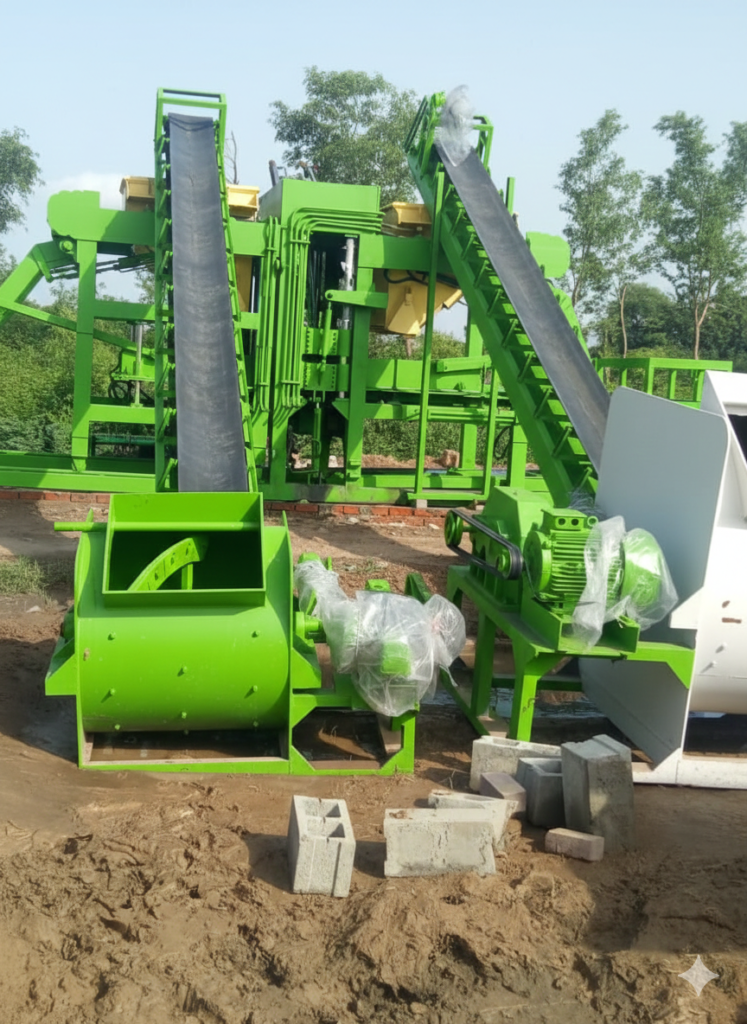
Compulsory Mixing Zone: The measured aggregates move up a heavy belt conveyor into a twin-shaft or pan mixer. Cement and water are added automatically to ensure a homogeneous, zero-slump concrete blend.
-
Molding & Compression Zone: The wet mix travels into the machine’s primary hopper and fills the lower die mould. The machine applies intense downward hydraulic pressure (up to 10,000 PSI) combined with high-frequency table vibration, removing all air pockets to pack the concrete tightly within seconds.
-
Automatic Stacking: The freshly pressed blocks travel forward on their wooden pallets into the automated stacker machine. The stacker groups the pallets vertically, making it easy for forklifts to safely transport them to the curing yard.
Project Feasibility: The Financial & Environmental Payback (SSM 35 Case Study)
Investing in an automated concrete block plant provides strong commercial returns compared to running an old-style clay brick kiln. Data from the SSM 35 Pre-Feasibility Study highlights the clear financial advantages for investors in Pakistan:
-
Daily Production Output: Based on a conservative single-shift schedule producing 24,000 fly ash bricks a day (with an estimated target of 500,000 bricks per month over 25 operational working days).
-
Manufacturing Cost vs. Market Value: The exact cost of production averages Rs. 12 per brick (including cement, aggregates, fly ash, labor, electrical power, and machinery depreciation). These units sell easily at a factory-gate price of Rs. 16 per brick.
-
Monthly Profit Profile: This margins-to-volume ratio yields a consistent net daily income of Rs. 80,000, translating to a monthly net operating income of Rs. 2,000,000.
-
Capital Investment Recovery: With a monthly operational budget of approximately Rs. 855,000 covering professional operators, loaders, fuel, and scheduled field maintenance, the entire initial capital expenditure achieves a payback period of just 15 months.
Beyond strong financials, automated block plants offer full regulatory compliance. Traditional brick kilns face frequent government closures during winter smog seasons to control air pollution. SSM automated concrete block machines run on clean electrical power and generate zero toxic smoke emissions. By actively recycling industrial waste like fly ash into valuable building materials, your business remains insulated from environmental shutdowns, ensuring steady, year-round revenue.
Partner with Pakistan’s Trusted Machinery Experts
Investing in automated block machinery is a major, long-term business decision. Partnering with an experienced local manufacturer like Silver Steel Mills gives you a clear competitive advantage:
-
World-Class Engineering, Local Prices: We handle all structural cutting, heavy hydraulic assembly, and electrical control panel programming in-house, allowing us to offer high-output, durable plant setups at a fraction of the cost of expensive imported foreign machinery.
-
Immediate Local Spare Parts Support: You never have to worry about long customs delays or dealing with overseas suppliers for basic maintenance. We keep a complete inventory of certified replacement parts—including custom CNC molds, replacement conveyor rollers, load cells, and hydraulic seals—right here in Pakistan for rapid support.
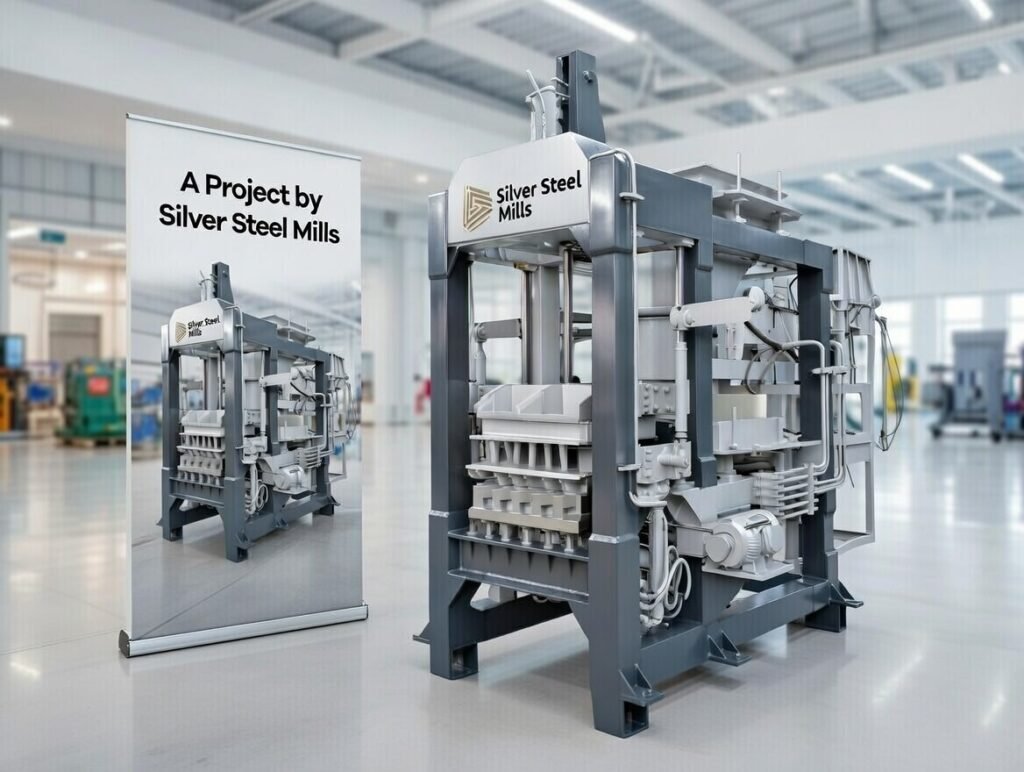
Whether you’re launching a new construction venture or upgrading your existing facility, our block making machines in Pakistan offer exceptional quality, competitive pricing, and nationwide support.
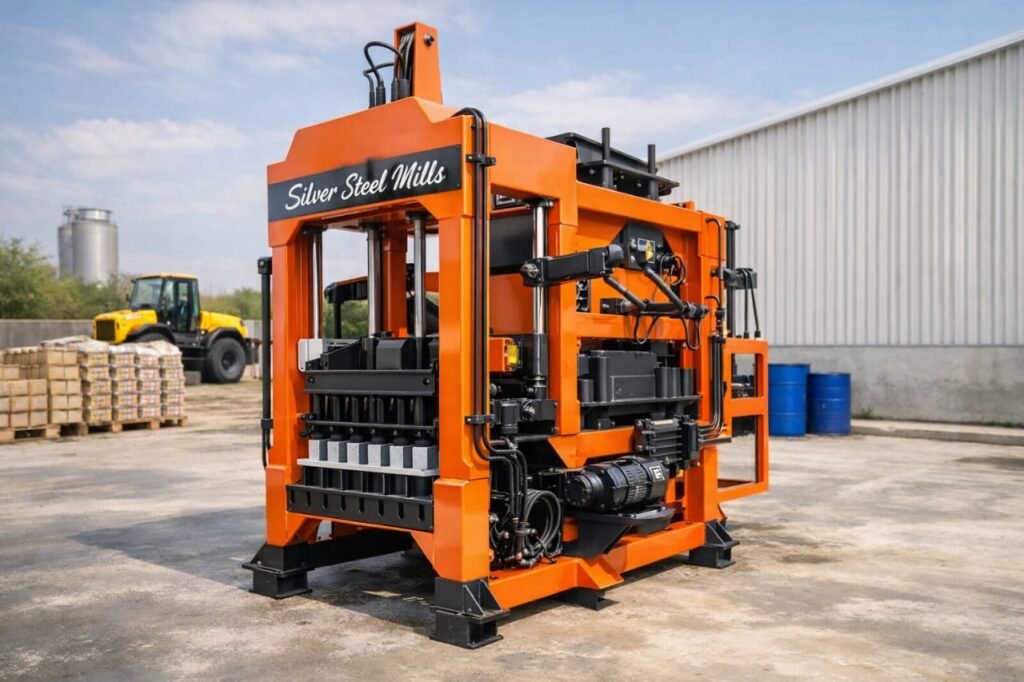
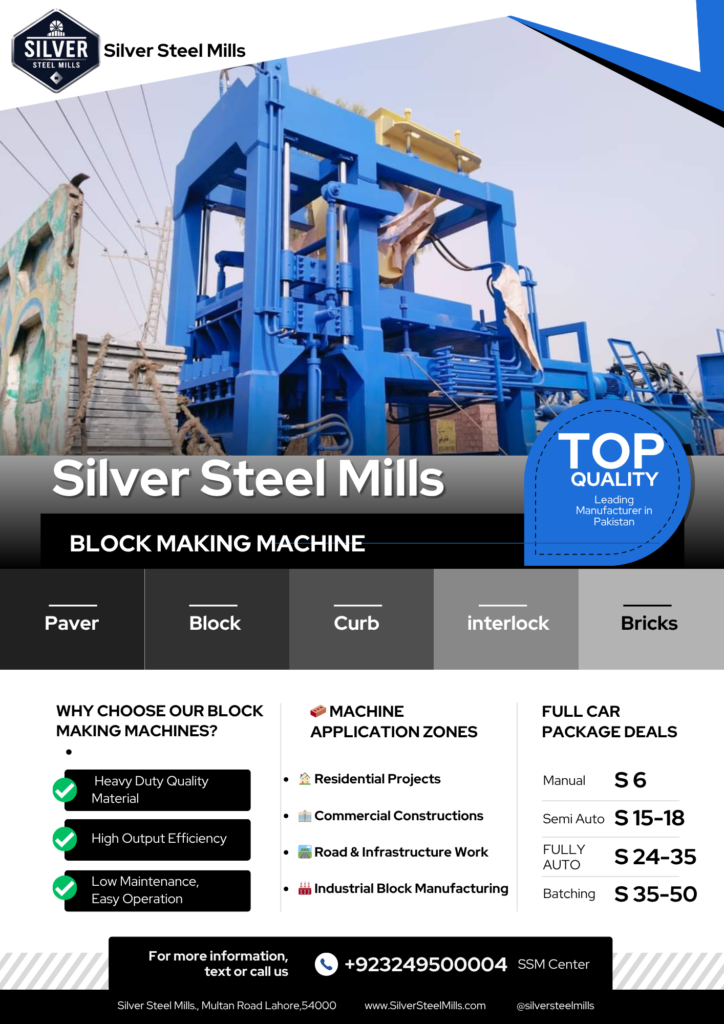
Why Choose Silver Steel Mills Block Making Machines?
Silver Steel Mills stands out in Pakistan’s construction machinery market due to:
-
Superior Engineering Design
-
Locally Manufactured Spare Parts
-
Advanced Technology with Durable Build
-
After-Sales Support & Service
-
Affordable Prices with High ROI
We manufacture a complete range of machines for hollow blocks, solid blocks, pavers, and curb stones, tailored for different scales of production.
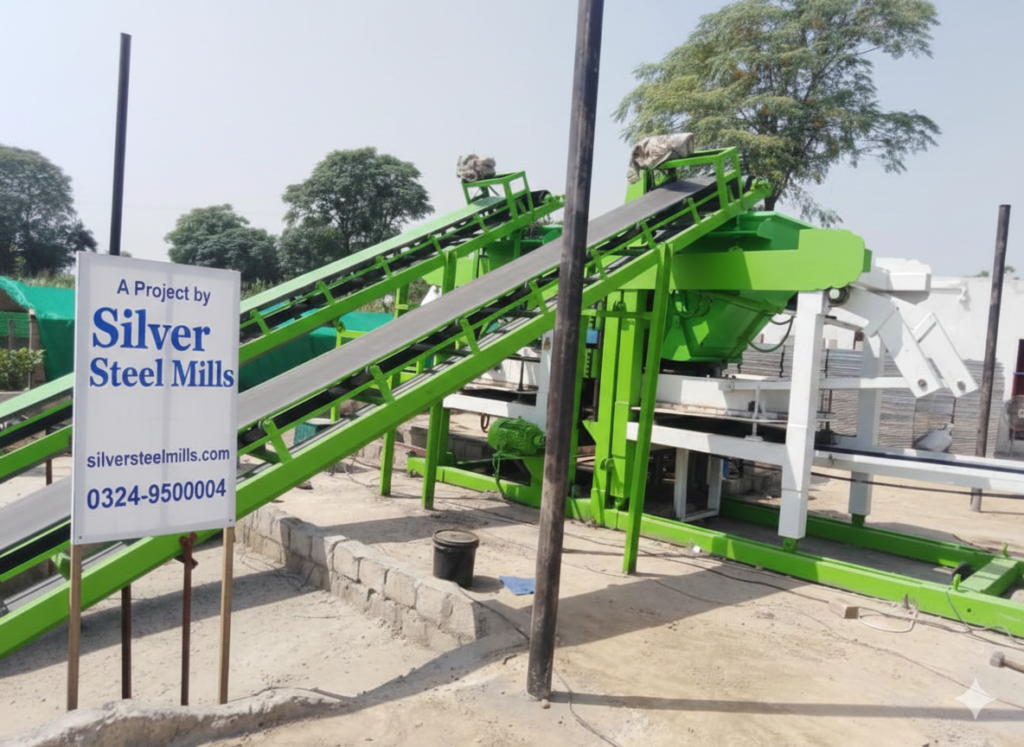
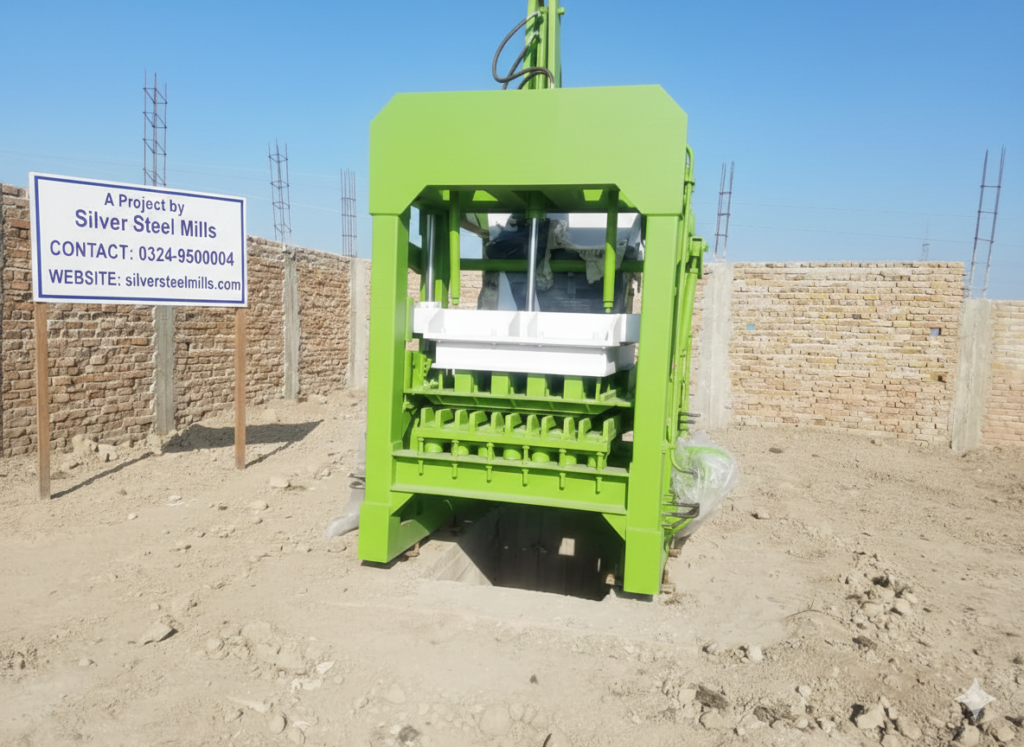
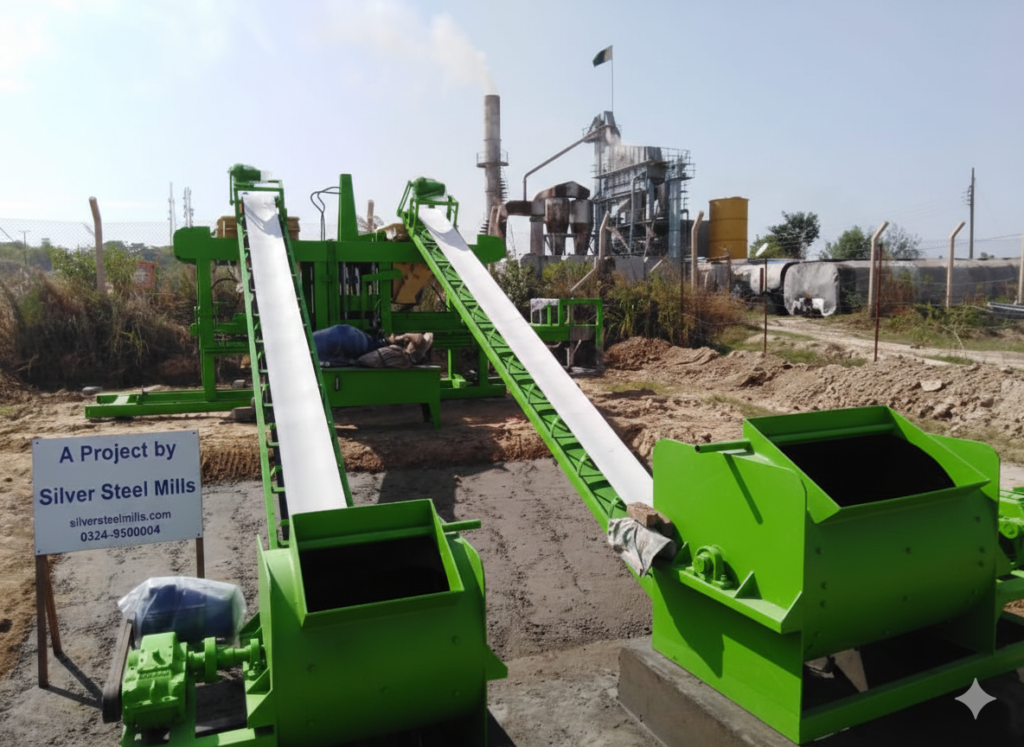
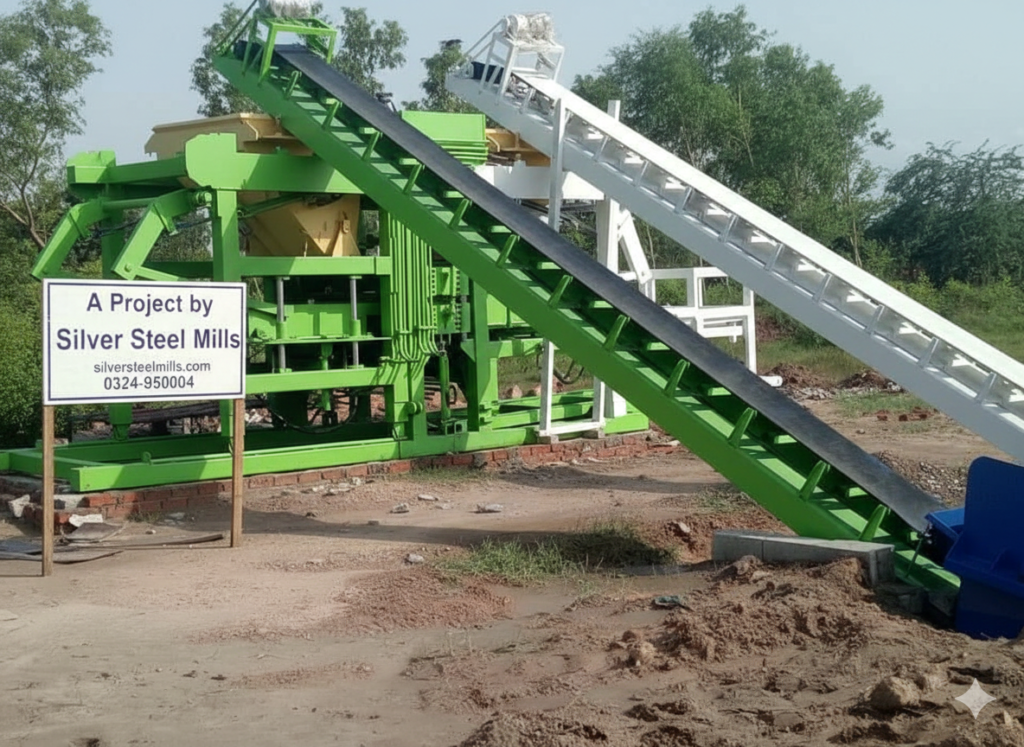
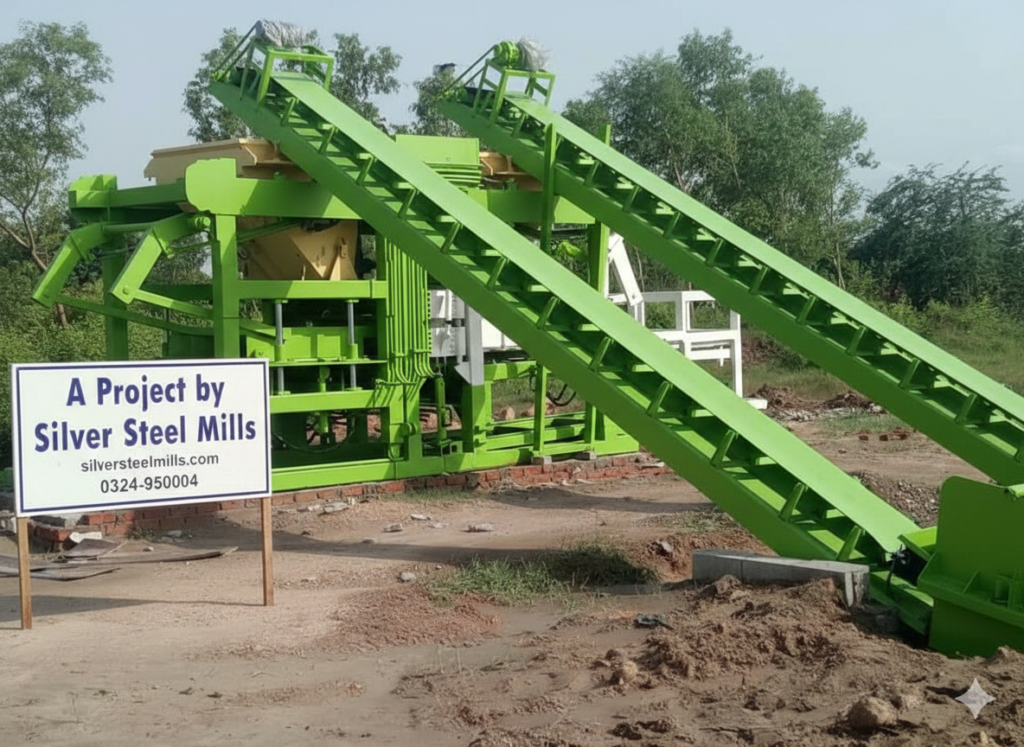
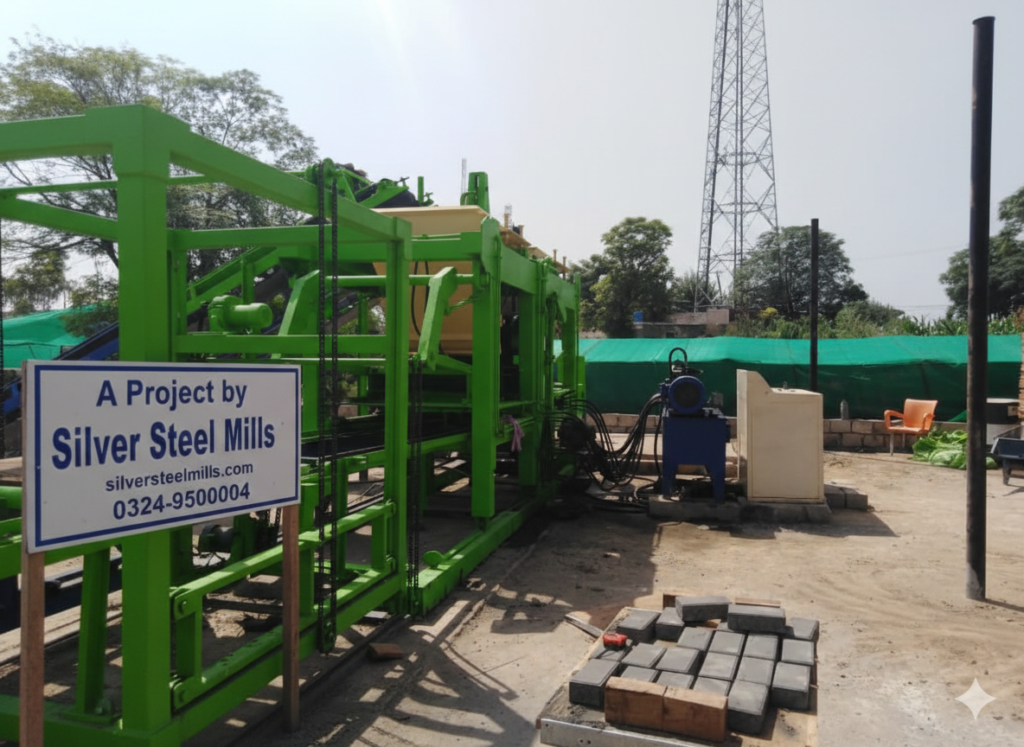
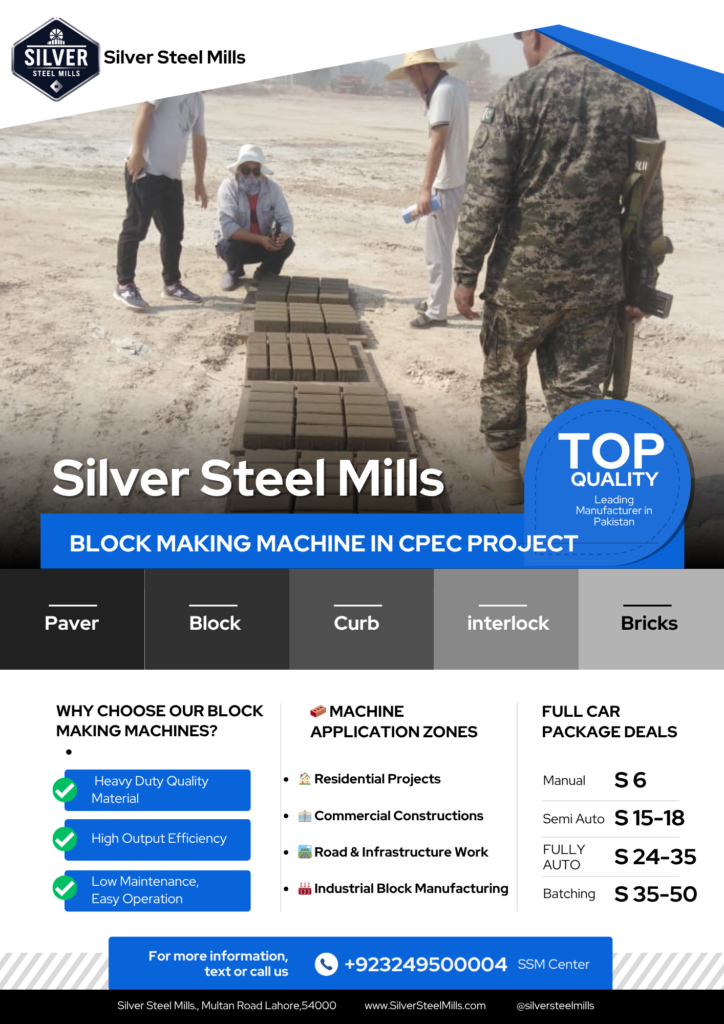
Popular Models of Block Making Machines by Silver Steel Mills
1. SSM-15 Block Making Machine
| Feature | Specification |
|---|---|
| Production Capacity | 4,000–5,000 blocks/8 hours |
| Block Types Supported | Hollow blocks, solid blocks, pavers |
| Operation Type | Semi-Automatic |
| Power Requirement | 12–15 kW |
| Mold Change Support | Yes |
| Hydraulic System | Yes |
✅ Ideal for medium-scale manufacturers looking for durable performance and customizable output.
2. SSM-24 Automatic Block Making Machine
| Feature | Specification |
|---|---|
| Production Capacity | 7,000–8,000 blocks/8 hours |
| Control System | PLC-Controlled |
| Automation Level | Fully Automatic |
| Mold Type | Interchangeable |
| Raw Material | Cement, sand, crush, fly ash, etc. |
| Production Line | With conveyor & mixer included |
✅ Perfect for industrial-scale manufacturers who want speed, consistency, and lower labor dependency.
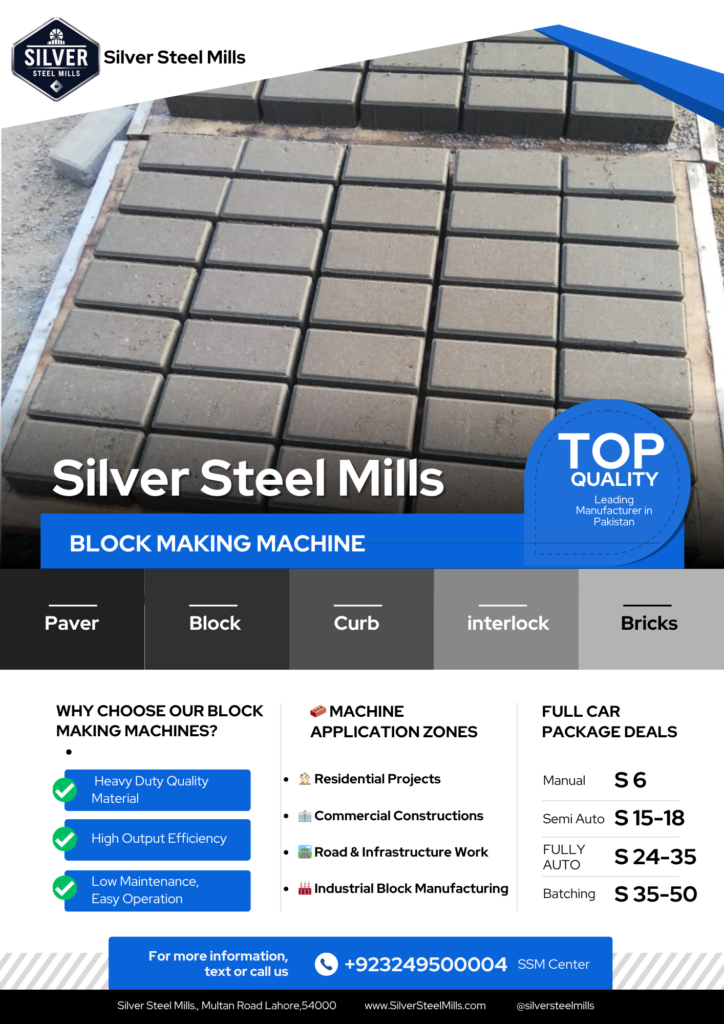
3. SSM-35 Industrial Block & Paver Machine
| Feature | Specification |
|---|---|
| Production Capacity | 10,000+ blocks/shift |
| Suitable Products | Blocks, Pavers, Curb Stones |
| Control | Advanced PLC with Touch Panel |
| Mixer | Twin-shaft Mixer |
| Material Feeding | Automatic Conveyor Feeding |
| Hydraulic Pressure | 18–20 MPA |
✅ Best suited for mega infrastructure and government contractors.
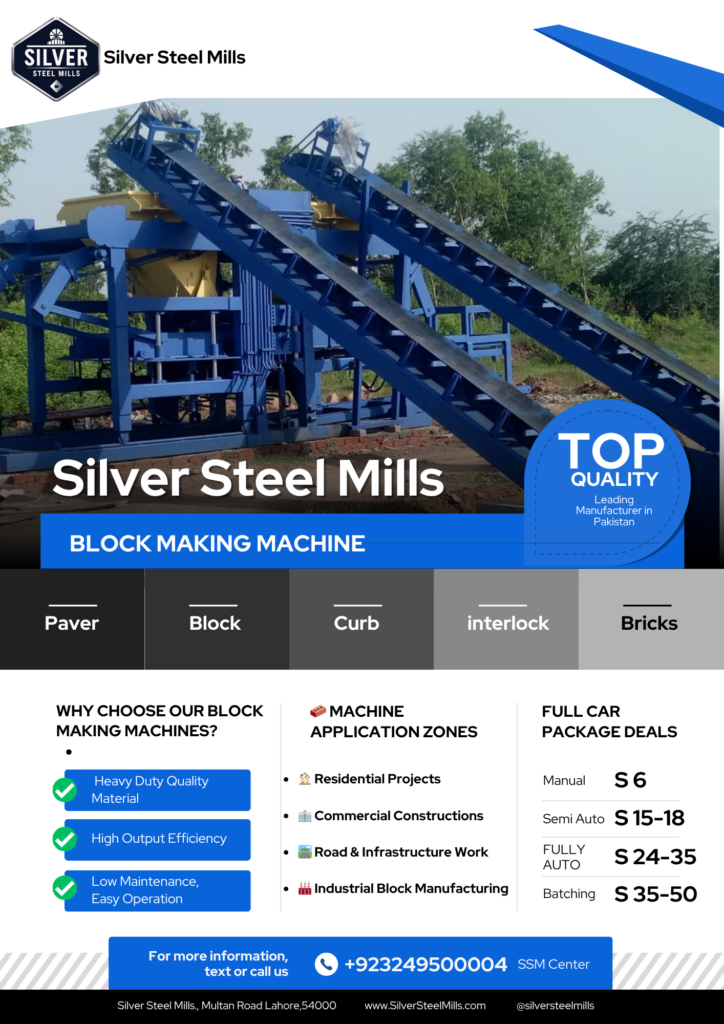
Applications of Silver Steel Mills Block Machines
-
Housing Schemes
-
Road & Highway Construction
-
Paver Manufacturing
-
Industrial Warehouses
-
Municipal Development Projects
Block Making Machine Price in Pakistan
The block making machine price in Pakistan varies depending on:
-
Production capacity
-
Level of automation (manual/semi/automatic)
-
Features (mixer, molds, hydraulic system)
-
Raw material compatibility
At Silver Steel Mills, our block machine prices start from PKR 9.5 Lakh for semi-automatic models, going up to PKR 45 Lakh for fully automated industrial lines.
We offer the best value for money — no compromise on strength, consistency, or technology.
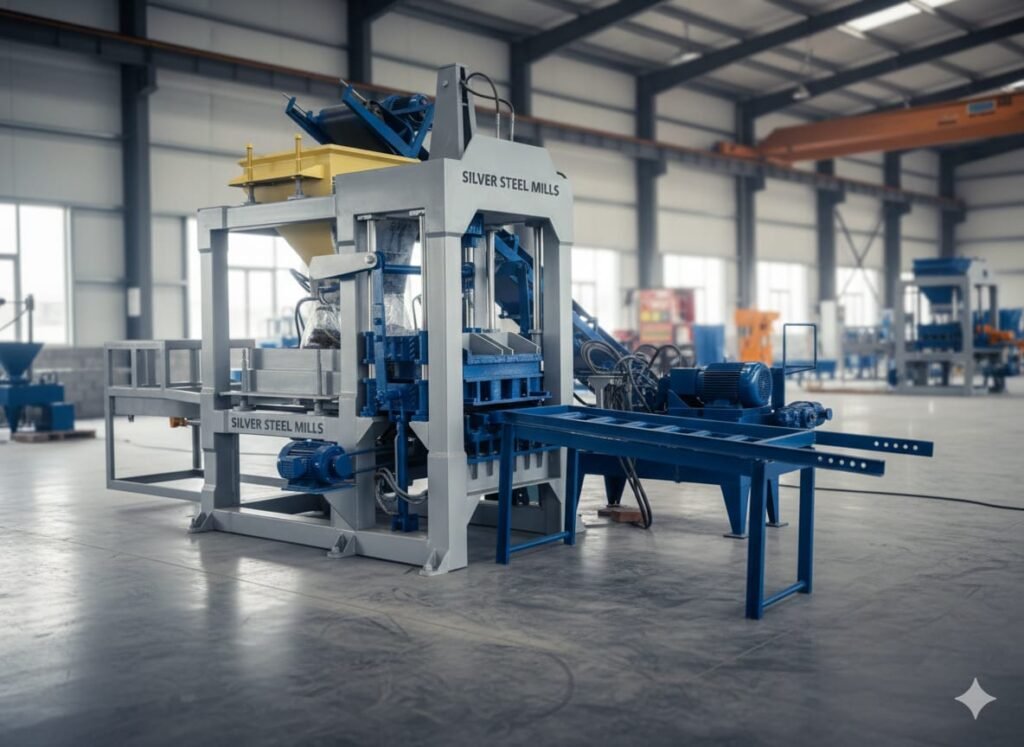
Nationwide Delivery and Support
Silver Steel Mills provides installation, training, and spare part support in major cities like:
-
Lahore
-
Karachi
-
Islamabad
-
Peshawar
-
Multan
-
Gujranwala
-
Sialkot
Our team ensures your machine is delivered, installed, and operational in the shortest possible time.
Benefits of Using Silver Steel Mills Block Machines
-
High Output with Less Power
-
Less Labor, More Automation
-
Low Maintenance Design
-
24/7 Technical Support
-
Mold Customization on Demand
FAQs – Block Making Machines in Pakistan
Q: Can I use the machine for pavers and blocks both?
A: Yes, all our machines are designed for multi-product molds.
Q: What raw materials are compatible?
A: Cement, sand, gravel, fly ash, slag, and more.
Q: Is training provided?
A: Yes, our technical team trains your staff on machine operation and troubleshooting.
Q: Can I get molds customized for my block size?
A: Absolutely! We offer complete mold customization.
Q: How long does delivery take?
A: 5 to 10 working days depending on location and model.
Final Words: Choose Silver Steel Mills – The Future of Block Making in Pakistan
With Silver Steel Mills, you’re not just buying a machine — you’re investing in long-term construction efficiency, quality, and profitability. Our block making machines in Pakistan are built to withstand the toughest conditions and deliver high performance with every cycle.
Concrete Block Making Machines: Pakistan mein Karobar ka Aik Naya Inqilab
Pakistan ki construction industry mein ab bhatte ki eent (red bricks) ka istemal kam aur Concrete Blocks ka trend tezi se barh raha hai. Housing societies hon, industrial plazas hon ya sarkon ke kinare lagne wali Tuff Tiles—har jagah modern machinery ki zaroorat hai.
Silver Steel Mills Pakistan ka wo wahid naam hai jo na sirf machines banata hai, balkay aapko aik mukammal industrial setup farahum karta hai. Hamari machines apni mazbooti, speed aur kam maintenance ki wajah se poore Pakistan mein mashhoor hain.
Hamari Block Making Machines ki Categories
Hum ne har level ke investor aur businessman ke liye mukhtalif models design kiye hain:
1. Manual aur Semi-Automatic Models (SSM 15 & SSM 18)
Ye machines un logon ke liye behtareen hain jo thori sarmaya kari (investment) se apna kaam shuru karna chahte hain.
-
Production: 100 se 110 pallets per hour.
-
Khosusiyat: Single trolley system aur asaan operating system.
-
Istemal: Small scale contractors aur local block providers ke liye behtareen.
2. Fully Automatic Models (SSM 24 & SSM 28)
Ye models “Batching System” ke saath aate hain, yani material ki mixing se lekar block banne tak ka kaam computerised control panel (PLC) ke zariye hota hai.
-
Double Layer System: In machines mein double trolley hoti hai jo Tuff Tiles aur Pavers par pigment (color) lagane ke liye behtareen hai.
-
Efficiency: Kam mazdooron ke saath zyada production.
3. Heavy Industrial Plants (GSM 35 & SSM 50)
Ye hamare sab se baray plants hain jo mega projects ke liye istemal hote hain.
-
GSM 35: 140 pallets per hour tak ki capacity.
-
SSM 50: Din mein 40,000 rectangle pavers banane ki salahiyat.
-
Spec: In mein 10,000 PSI tak ka hydraulic pressure hota hai jo block ko pathar jaisa sakht bana deta hai.
Technical Specs jo Humien Mumtaz Banati Hain
Humari machines ki lambi umar ka raaz un ke material mein chupa hai:
-
Imported Steel: Hum Q235 MS Imported Sheet aur SS Chrome Shafts istemal karte hain.
-
Hydraulic Power: 21-gallon ke heavy-duty pumps aur cooling system taake machine lagatar 24 ghante chal sake.
-
Vibration Technology: High-frequency vibration motors jo material ko achi tarah compact (press) karti hain.
-
Precision: Har machine CNC machining aur engraving ke zariye banai jati hai taake har block ka size bilkul barabar ho.
Block Making Business: Munafa aur Scope
Agar aap ye karobar shuru karte hain, to aap ko munafe ke mutalliq pareshan hone ki zaroorat nahi:
-
Raw Material ki Asani: Cement, crush aur rait har shehar mein ba-asani mil jati hai.
-
Kam Production Cost: Machine ke zariye banne wala block eent ke muqable mein sasta parta hai aur is ki deewar jaldi khari hoti hai.
-
Har Mausam mein Kaam: Bhatta barish mein band ho jata hai, lekin block plant shed ke neeche poora saal chalta hai.
Silver Steel Mills se Machine Kyun Kharidien?
Hum sirf machine farahum nahi karte, balkay humara sath installtion ke baad bhi rehta hai:
-
3 Month Free Service: Hum 3 mahine tak free technical service farahum karte hain.
-
Trained Workers: Hum aapke plant ke liye expert operator aur labor recommend karte hain.
-
Foundation Layout: Plant lagane se pehle hum civil work ka mukammal naksha (layout) dete hain.
-
Customization: Aap apni zaroorat ke mutabiq Die (Mould) banwa sakte hain—chahe wo Hollow block ho, Solid block ho ya zigzag tuff tile.
Aksar Pooche Janay Walay Sawalat (FAQs)
Q: Kya Silver Steel Mills poore Pakistan mein delivery deta hai? A: Ji bilkul, hum factory se loading aur transportation manage kar sakte hain, jo buyer pay karta hai.
Q: Machine chalane ke liye kitni bijli ki zaroorat hoti hai? A: Model ke hisab se 60 HP se lekar 160 HP tak ka load darkar hota hai. Hum energy-efficient motors istemal karte hain taake bijli ka kharcha kam aye.
Q: Ek machine se kitne qism ke blocks ban sakte hain? A: Aap sirf “Die” change kar ke aik hi machine se 10 se zyada qism ke designs (Bricks, Tiles, Blocks) bana sakte hain.
Pakistan Me Block Making Machine Ka Karobar: Silver Steel Mills Ki High-Quality Models
Aaj kal Pakistan me construction ka kaam itni tezi se barh raha hai ke sasti aur mazboot bricks (eento) ki demand kabhi khatam nahi hoti. Agar aap aik aisa karobar talaash kar rahe hain jo saal ke 12 mahine chale, to Concrete Block Making Machine aik behtareen investment hai.
Lekin sawal ye hai ke machine kahan se li jaye? Pakistan ki market me Silver Steel Mills aik aisa naam hai jo sirf machine bechta nahi hai, balkay apko aik mukammal setup bana kar deta hai.
1. Silver Steel Mills Hi Kyun? (Real Experience)
Market me halki chadar aur purani motors wali sasti machines bohat hain, jo do mahine baad vibrate ho kar phat jati hain. Silver Steel Mills ki machines ki khasiyat unka Heavy-Duty Structure hai.
-
Mazboot Material: Humari machines me high-grade steel use hota hai jo heavy vibration bardasht karta hai.
-
Precision Engineering: Block ka size 19-20 nahi hota, har block ek jesa nikalta hai.
-
Customer Support: Machine lagane se lekar chalane tak, Silver Steel Mills apne clients ko guide karta hai.
4. Block Business Me Profit Kitna Hai?
Chalein thora hisab lagate hain (Andazan):
-
Aik standard 4x8x12 block banane ki cost (material + bijli + mazdoori) takreeban Rs. 35-45 tak aati hai.
-
Market me yehi block Rs. 55-70 tak sale hota hai.
-
Agar aap din ke 2,000 blocks bhi banayein, to kharcha nikal kar aik din ka Rs. 20,000 se 30,000 tak munafa mumkin hai.
5. Silver Steel Mills Buyer Guide: Machine Lene Se Pehle Ye Check Karein
Jab bhi aap hamare paas ya kisi bhi manufacturer ke paas jayein, ye 3 cheezein zaroor dekhein:
-
Vibration System: Kya vibration pure mould par barabar hai? Agar nahi, to block kacha rahega.
-
Hydraulic Press: Kya pressure itna hai ke block andar se khokla na rahe?
-
Mould Quality: Mould ki plate ki thickness check karein, yehi machine ki jaan hoti hai.
Frequently Asked Questions (FAQs)
Q1: Kya ye machine single-phase bijli par chal sakti hai?
Ji haan, humari small aur medium machines ko hum single-phase motors par bhi customize kar sakte hain taake aap ghar ya choti jagah se kaam shuru kar sakein.
Q2: Machine ki warranty kya hoti hai?
Silver Steel Mills apni har machine ke structure aur major components par technical warranty deta hai.
Q3: Kya blocks, eento (Red Bricks) se behtar hain?
Bilkul! Blocks lagane me waqt kam lagta hai, cement kam kharch hota hai, aur ye garmiyon me kamra thanda rakhte hain. Isi liye log ab blocks ki taraf shift ho rahe hain.
Q4: Delivery poore Pakistan me mil jayegi?
Ji bilkul, Karachi se Gilgit tak humari machines deliver hoti hain aur humara technician setup ke liye sath jata hai.
Conclusion
Showing all 12 results
-
Sale!

Automatic Block Making Machine Price in Pakistan: Your Guide to the Best Machines
Original price was: ₨10,000,000.₨9,900,000Current price is: ₨9,900,000. Add to cart -
Sale!
Block Machine for Sale in Pakistan – Tuff Tile Plant For Sale in Pakistan
Original price was: ₨4,500,000.₨4,400,000Current price is: ₨4,400,000. Add to cart -
Sale!

Block Making Machine in Gujranwala – Block Making Machine in Pakistan
Original price was: ₨4,600,000.₨4,500,000Current price is: ₨4,500,000. Add to cart -
Sale!

Block Making Machine price in Pakistan – Professional Guide for 2026
Original price was: ₨4,500,000.₨4,200,000Current price is: ₨4,200,000. Add to cart -
Sale!

Brick Making Machine for Sale in Pakistan: Benefits, Profits, and Business Ideas
Original price was: ₨4,500,000.₨4,400,000Current price is: ₨4,400,000. Add to cart -

Fly Ash Bricks Machine Price in Pakistan
Read more -
Sale!
Manual Block Making Machine Price in Pakistan: Comprehensive Guide for 2025
Original price was: ₨600,000.₨560,000Current price is: ₨560,000. Add to cart -
Sale!
Paver plant in Pakistan – paver plant machine in pakistan
Original price was: ₨4,500,000.₨4,400,000Current price is: ₨4,400,000. Add to cart -

Second Hand Block Making Machine in Pakistan: Features, Pricing, Specs, Use Cases, Benefits, and Buying Guide
Read more -
Sale!

Tuff Tile Machines -Tuff Tile Machines For Sale in Pakistan
Original price was: ₨45.₨40Current price is: ₨40. Add to cart -

Tuff Tile Plant for Sale in Pakistan: A Comprehensive Guide
Read more -
Sale!

Used Block Making Machine for Sale in Pakistan – Affordable, Tested, High-Quality
Original price was: ₨4,500,000.₨4,300,000Current price is: ₨4,300,000. Add to cart