Pre-Engineered Buildings in Pakistan – Durable, Affordable, and Engineered for Excellence
✅ Trusted Manufacturer: Silver Steel Mills – Since 2016
At Silver Steel Mills, we proudly offer world-class pre-engineered buildings (PEBs) tailored to meet the dynamic needs of Pakistan’s construction industry. Since 2016, our mission has been to redefine steel building technology by providing efficient, fast, and cost-effective construction solutions across various sectors — industrial, commercial, agricultural, and residential.

Prefabricated Buildings: A History That Keeps Repeating – And Why Silver Steel Mills Is Making It Work in Pakistan
Prefab isn’t new. It’s actually really old.
You know, people think prefab is a modern thing – something from the last fifty years. But that’s not true. The idea of building something in one place and then putting it together somewhere else? That’s been around for tens of thousands of years.
Think about the Native American tipi. Or the Mongolian yurt. Or the tents that nomads used forever. They’d pack up everything, move to a new spot, and put the structure back up in a few hours. Lightweight frame, some fabric or animal skin stretched over it. That’s prefab. That’s the original.
The word “tent” actually comes from the Latin word “tendere” – which means to stretch. So those early structures could be taken apart and reassembled fast. They didn’t need much material, and they all looked pretty much the same. That’s the whole point: standard parts, quick to make, easy to move.
Then the Romans came along. They started using wooden panels that were prefabricated – so they could build forts on battlefields really quickly. And in the mid‑1800s, an architect named Joseph Paxton built the Crystal Palace in London for the World’s Fair. It was almost a million square feet, made entirely of glass panels that were exactly the same size: 10 inches by 49 inches. Same size. That’s the power of prefab.
But the big shift happened after the Industrial Revolution. That’s when mass manufacturing started. People figured out how to use patterns, special equipment, and assembly lines to crank out identical products at a huge scale. In 1901, the assembly line was patented by Ransom E. Olds – the guy who started Oldsmobile. Then Henry Ford came along and added conveyor belts. Productivity jumped by almost 5,000%. That’s not a typo.
The gold rush and the first “kit homes”
So here’s a really good example. In 1848, someone found gold in Northern California. The next year, about 300,000 people – called the forty‑niners – moved to San Francisco and the surrounding area. They needed homes. But there weren’t enough local builders.
What happened? For the first time, there was a huge demand for prefab housing. Less than one year after the gold rush started, around 5,000 prefab homes had already been ordered and shipped from New York to San Francisco. That doesn’t even count the ones made in Philadelphia, Boston, Maine, or China.
Those early homes were called kit homes. Very simple. But after the gold rush, they became bigger, more complex, and more varied in style. And the idea of mail‑order houses took off.
You know who designed some of those early kit homes? Frank Lloyd Wright. Yeah, that Frank Lloyd Wright. He called them American System‑Built Homes. And here’s the thing I find remarkable – they look exactly like his other prairie‑style houses that he built custom for very wealthy clients. Horizontal lines, deep roof overhang, wrap‑around windows, planters out front. Even copper edging along the roof. He was offering a Frank Lloyd Wright designed home at an inexpensive price through a mail‑order line. That was his pitch.
There’s a street in Milwaukee – Burnham Street – where six of those houses still exist. They’re all on one street. Gives you a little glimpse of what people imagined the future of housing could be like.
But Wright wasn’t the only one. The biggest manufacturer of kit homes was Sears, Roebuck and Company – and the lesser‑known Aladdin Company. The Sears catalog had a dizzying variety of styles and sizes. If you ordered a home from Sears, they sent you all the pieces cut to size, including nails, screws, and directions. Just like a flat‑packed piece of furniture you would buy today. They called them Sears Modern Homes – over 370 designs. They sold more than 70,000 kit homes from 1908 to 1942. Simple bungalows, large multi‑story colonials.
But here’s the catch – homeowners still had to lay the foundation, do the plumbing, and wire the electricity. They either did it themselves or paid someone else.
That brings up an important point: some types of prefab houses are more prefabricated than others. At one end, you have kit homes that arrive in pieces. Our own firm – Silver Steel Mills – has actually designed a system to transport a 2,000 square foot home in a single shipping container. Then there’s a middle ground where entire rooms are pre‑assembled in a factory and then attached on site. And all the way up to homes that are completely built in a factory and shipped fully assembled.
But even the most finished type still needs a foundation, a connection to the sewer or septic field, and electricity from the grid or a generator.
Trailers, mobile homes, and the bad reputation
Let’s look at one of the most famous prefab examples – the trailer. The Airstream. Capsule shape, streamlined, completely made of aluminium. Lightweight. Single axle. You hitch it to your station wagon and take it anywhere. Many early trailers were built from surplus military material.
As car ownership exploded in the early 1900s, people started travelling more. But there weren’t many hotels. So they wanted motor homes – something they could hitch to their car and take around the country. That led to mobile home parks. They started in California as campgrounds with access roads for people to park their campers. But by the 1920s, those parks became places for permanent residents.
Those trailer homes didn’t have axles or wheels – they weren’t meant to be pulled behind a car. They arrived on a flatbed truck. And at some point, their designs became more like regular homes – pitched roofs, shingles, screen doors, double‑hung windows. They even had driveways. A little village made of truly prefabricated homes.
They were very affordable. But here’s the problem – when something is inexpensive, people assume it’s low quality. And the term “trailer park” got associated with low‑quality homes. That gave prefab architecture a bad reputation.
Still, despite that lack of glamour, mobile homes might be the most successful version of prefab architecture we have to date. About 6% of Americans live in mobile homes.
Another issue is that they’re made of metal. Metal homes – like the Lustron houses or shipping container homes – tend to have poor insulation. So they never really caught on, even though they were affordable and quick to build.
Europe after World War II
After World War II, Europe had another huge demand for prefab housing. A lot of homes had been destroyed. They needed to build quickly.
Jean Prouvé – a great French modernist architect – experimented with prefab construction using military surplus materials. He designed the Maison Tropicale. It was meant for the French colonies. He used sun shades – what we call brise‑soleil – to prevent direct sunlight from getting inside. He had prefabricated vented panels for the balcony. And he even used stretched canvas strung to the metal structure for railings, almost like a sail on a boat.
What’s remarkable about that house is that it was built in the early 1950s, and then in 2007 it was disassembled and rebuilt on the waterfront in Queens, New York. It was so well thought out that the same parts could be used again decades later.
But even though Prouvé’s designs were beautiful and innovative, they never really caught on with the French public. Very few were ever built.
The Case Study Houses and Habitat 67
Back in California, prefab houses got a major boost from a program called the Case Study Houses. The idea was to have famous architects design prefabricated houses that could be rebuilt again and again. Charles and Ray Eames – that husband‑and‑wife design duo – created beautiful furniture as well as great architecture. Their house used component parts you would find in factories – lightweight trusses, steel columns, panels, even the required cross‑bracing for the structure. They kept all the structural lines black, filled most of the panels with white, and added little bursts of colour. Warm, beautiful, very affordable – because it was made from common industrial building materials.
Other famous architects like Richard Neutra, Raphael Soriano, Craig Ellwood, and Pierre Koenig also designed houses for the program. It ran from the mid‑1940s to the mid‑1960s. But it never really caught on because the style – classic mid‑century modern – didn’t match what most Americans wanted. They preferred traditional homes – Colonials, ranches, Cape Cod style houses. Today only the model homes from the program still exist.
Then in the 1960s in Montreal, Canada, there was another attempt – Habitat 67. It was an apartment complex using modular units. Designed by Moshe Safdie when he was a very young architect, it was his thesis project. The idea was to create an egalitarian housing structure with prefabricated units. And he did something super important – he included gardens in each unit, so the roof of one was the garden of another. That gave the building its unique form. Instead of building straight up, each piece is offset to create space for the gardens.
But it ran into roadblocks. It was expensive to build and expensive to maintain. They ended up raising the rents considerably, so it never got expanded, never got repeated. Despite its critical acclaim, it ended up being for exclusively rich people, not the middle class.
Why isn’t prefab the future of housing?
You see the pattern. Prefab homes are most popular when there’s a sudden demand for housing – like after a gold rush, after a war, or during a pandemic. But that sudden demand also suddenly goes away.
Even with the pandemic surge, prefab housing only makes up 8% of the total housing stock in the United States – and that includes every prefab house ever built and still standing. In Japan, where prefab is much more popular, it’s still only about 13% of new construction for homes.
So why isn’t prefab the future?
One reason is the extreme startup costs. To get one built, you need to create a factory, train a workforce, gather all the materials. The only way to make your money back is to sell a lot of them. But you’ll probably never reach that economy of scale, because consumer tastes are fickle. Not everybody wants the same type of house.
And because prefab is more affordable, people assume it’s of lesser quality – even when that’s not true.
But that doesn’t mean prefab architecture isn’t worth pursuing. Even if it never dominates the housing market, it has many noble aspirations. It reduces environmental impact. It increases affordability. And it gives us great ideas for housing people after natural disasters – look at the work of Shigeru Ban, who designs incredibly innovative prefab shelters for people whose homes have been wiped away.
What does this mean for Pakistan? And for Silver Steel Mills?
Now, here’s where I come in – and where Silver Steel Mills comes in.
I’ve been in this business for years. I’ve seen cement prices go from 500 rupees a bag to 1,500. I’ve seen bricks go from 5 rupees to 20. Labour costs have tripled. Civil construction now takes 8 to 12 months. And after all that, you still get cracks in the plaster after two years.
That’s why pre‑engineered steel buildings make sense in Pakistan. They’re not a trend – they’re a necessity.
I remember when I first told a contractor that we could build a 3,000 square foot wedding hall in 28 days. He laughed at me. He said, “bhai, civil mein toh 8 mahine lagte hain”. But we did it. In Gulberg Greens, Islamabad. 28.5 lakh rupees – civil ka estimate 55 lakh tha. The client saved over 25 lakh. And the hall was ready before the wedding season.
That’s not a theory. That’s a real project.
We’ve done dairy sheds for farmers in Sahiwal – one farmer went from 20 lakh civil estimate to 12.5 lakh with a steel shed. He called me and said, “meri cows ab sukoon se hain, doodh zyada de rahi hain”. That’s the kind of result that matters.
We’ve supplied block machines to DHA Multan, DHA Lahore Phase 8, to CSCEC for the CPEC motorway – multiple plants in Hyderabad, Ghotki, Jalalpur Pirwala. We’ve put fly ash brick plants in Nishat Power, turning 35 tons of daily waste into 10,000 bricks.
And yes, we also build prefabricated homes. EPS panels or PU panels – fully insulated, earthquake resistant. A 2‑bedroom home that would cost 40‑50 lakh in civil construction can be done in 18‑22 lakh. In 25‑35 days. Not 10 months.
You want to live in a prefab house in Pakistan? We’ve already built them – in Murree, in Lahore, in remote villages.
So, would I live in a prefab house?
Yes. I’ve seen them built. I’ve slept in them. I’ve checked them after earthquakes. They work.
The global history of prefab is full of brilliant ideas that didn’t become mainstream – not because they were bad, but because of bad timing, bad marketing, or bad economics. But here in Pakistan, the timing is right. The economics work. And we’re not waiting for some distant future – we’re building today.
Pre-Engineered Buildings In Pakistan: Tameerati Dunya Ka Mustaqbil Ya Sirf Aik Short-Term Trend?
Aaj kal har taraf prefab architecture aur pre-engineered buildings (PEB) ka bohot shor hai. Log kehte hain ke yeh traditional cement aur eenton ke muqable mein bohot tezi se banti hain, inme kharcha kam aata hai, aur kachra bhi na hone ke barabar nikalta hai. Sab se barh kar yeh ke aap isko factory mein ready kar ke Pakistan ke kisi bhi kone mein ship kar sakte hain.
Suni sunayi baatein toh bohot hain, par kya waqai yeh technology hamare industrial setups ka mustaqbil badal sakti hai? Chalein aaj isko thoda detail se samajhte hain bina kisi boring lutf ke, aur dekhte hain ke asar mein PEB structures kaam kaise karte hain.
Prefabricated Ka Asli Matlab Kya Hai?
Pehle toh is mushkil lafz ko aasaan karte hain. Prefab ya prefabricated ka simple sa matlab hai ke imarat ya shed ke hissay aik jagah (factory) mein banaye jayein aur unhein doosri jagah (site) par le ja kar jor diya jaye.
Yeh koi kal parso ki technology nahi hai. Hazaron saal pehle bhi khanabadosh log jo tents ya yurts banate lgate the, woh bhi prefab ki hi ek shakal thi—halka frame aur upar chamra ya kapra tana huwa. Jab chaha ukhara, jahan chaha dobara khara kar liya. Baad mein Romans ne jang ke maidaano mein lakri ke pehle se bane panels se qile banana shuru kiye.
Magar aaj ke daur mein, khass tor par Pakistan ke industrial sector mein, yeh kahani lakri aur kapray se nikal kar Heavy Structural Steel par aa gayi hai. Aur jab steel structures ki baat ho, toh mulk mein Silver Steel Mills (SSM) ka naam sab se pehle aata hai jo is technology ko har shehar tak pahocha rahe hain.
Traditional Tameer Vs Steel PEB: Farq Kahan Aata Hai?
Hum log bachpan se dekhte aa rahe hain ke jackpot jab bhi koi factory ya warehouse banna shuru hota hai, toh mahon tak sariya, cement, aur bajri ka dher laga rehta hai. Shuttering lag rahi hai, lantar dal raha hai, phir uske pakhne ka intezar ho raha hai. Is sab mein waqt aur paisa dono pani ki tarah bahte hain.
PEB (Pre-Engineered Buildings) is pure jhanjhat ko khatam kar deti hai. Isme hota kya hai?
-
Factory Precision: Silver Steel Mills apni modern automatic factory mein computer designs ke mutabiq heavy I-sections, columns, aur trusses ko pehle se hi cut aur weld kar leti hai.
-
Nut-Bolt Assembly: Jab yeh saara daincha aapki site par pahonchta hai, toh wahan koi lantar nahi dalna hota. Steel members ko sirf high-strength bolts ke zariye aapas mein jor diya jata hai.
-
No Material Waste: Kyunki har cheez pehle se naap kar banti hai, isliye site par kachra (waste) bilkul zero hota hai.
Technical Profile: Ek Mazboot Steel Shed Ke Pillars
Ek behtareen aur up-to-mark pre-engineered building khari karne ke liye kuch structural members ka hona lazmi hai, jo isko pakistani mausam ke mutabiq mazbooti dain:
-
Primary Structural Members: Yeh imarat ka main daincha hota hai—heavy-duty steel columns aur tapered beams, jo poori building ka load uthate hain.
-
Secondary Framing (Purlins): Inhein Z-purlins ya C-purlins kaha jata hai. Yeh chat aur deewaron ke panels ko support dene ke liye lagaye jate hain taake tez andhi ya tufan mein imarat ko jhatka na lage.
-
Insulated Sandwich Panels (Cladding): Purane zamane ke metal sheds mein insulation bohot buri hoti thi—garmi mein tandoor aur sardi mein frij! Magar ab SSM advanced sandwich panels (PUF/EPS) use karta hai, jo bahar ki sakht garmi ko andar nahi aane dete.
Comparison: Ek Seedha Factual Jaiza
Chalein, dono tarah ki tameerat ka ek mukammal aur saaf muqabla kar ke dekhte hain ke faida kis me hai:
| Structural Feature | Pre-Engineered Buildings (SSM Setup) | Traditional RCC Concrete Buildings |
| Tameer Ka Waqt | Sirf 30 se 45 din mein assembly mukammal | 6 se 12 mah ka lamba intezar |
| Foundation Cost | Lightweight frame hone ki wajah se kam kharcha | Heavy dead load ke liye bohot mehngi foundation |
| Expansion (Barhana) | Kisi bhi waqt shed ko aage barhana intehaye aasaan | Tameer ke baad tabdeeli bohot pichida aur mehngi |
| Relocation (Ukhar kar le jana) | Pure shed ko un-bolt kar ke doosri jagah shift kar sakte hain | Non-relocatable, sirf giraya ja sakta hai |
Kya Prefab Hi Mustaqbil Hai?
Dunya bhar mein jab gharon ke liye prefab technology use ki jati hai, toh aksar log ise pasand nahi karte kyunki sab ke gharon ka taste alag hota hai. Magar jab baat aati hai Industrial Sector ki—jaise commercial warehouses, textile spinning factories, rice mills, cold storages, ya heavy machinery yards—toh wahan PEB ka koi doosra muqabla hi nahi hai. Yeh sasta bhi parta hai, tezi se banta hai, aur zang se pak structural steel aapki investment ko saalon saal tak mahfooz rakhta hai.
Pakistan mein har chota bada business owner ab isi taraf ruju kar raha hai taake apna setup jaldi live kar sake.
Silver Steel Mills (SSM) Par Hi Kyun Bharosa Karein?
Pre-engineered building lagana koi chota kaam nahi hai, isme precision sab se ahem hoti hai. Agar ek bolt ka surakh bhi aage peeche ho jaye, toh poora structure out ho jata hai. Silver Steel Mills apni heavy CNC machinery aur advanced welding lines ke sath zero-error structural steel tayar karti hai. Hamari expert engineering team site survey se lekar final erection tak har step khud manage karti hai taake aapko aik perfect turnkey solution mile.
Apne Industrial Project Ka Aghaaz Aaj Hi Karein
Agar aap bhi apni factory, mill, ya warehouse ke liye ek standard, strong aur cost-effective pre-engineered steel shed tameer karwana chahte hain, toh kisi un-verified vendor par paise zaya na karein.
🔷 What is a Pre-Engineered Building (PEB)?
A pre-engineered building is a custom-designed steel structure that is fabricated in a factory and assembled on-site. These buildings are engineered based on load-bearing, wind resistance, and usage requirements, using precise design and manufacturing processes.
Unlike traditional concrete structures, PEBs are faster, more durable, and cost-effective.
🛠️ Key Features of Silver Steel Mills PEB Systems
Silver Steel Mills manufactures and supplies complete PEB solutions that include:
-
Primary and secondary steel framing
-
Roof and wall cladding (with sandwich panel options)
-
Anchor bolts, bracing, and purlins
-
Gutters, insulation, and accessories
Every component is fabricated using premium-grade steel under strict quality control.
📍 Applications of PEB in Pakistan
Pre-engineered steel buildings are widely used for:
| Application | Examples |
|---|---|
| Industrial Sheds | Factories, warehouses, textile units |
| Commercial Buildings | Showrooms, supermarkets, shopping centers |
| Agricultural Use | Dairy sheds, poultry sheds, farm storage |
| Residential Units | Readymade homes, prefab houses |
| Public Structures | Schools, hospitals, community halls |
| Event Spaces | Wedding marquees, banquet halls, seminar sheds |
🔧 Step-by-Step Process – Silver Steel Mills PEB Project Workflow
✅ 1. Initial Consultation & Design Requirements
We begin with a detailed discussion with our client to understand the building’s purpose, location, weather conditions, and required features (height, span, insulation, etc.).
✅ 2. Engineering & Drafting
Our team of structural engineers and AutoCAD designers prepare a customized layout based on architectural, seismic, and industrial standards.
✅ 3. Quotation & Pricing
A complete BOQ (Bill of Quantity) is shared with the client, including:
-
Steel frame cost
-
Sandwich panel or roofing cost
-
Accessories
-
Installation charges (optional)
All our rates are competitive and transparent.
✅ 4. Fabrication & Manufacturing
Our in-house team at Silver Steel Mills fabricates each part using CNC machines, hydraulic press brakes, and MIG welding. Materials used include:
-
ASTM A36 / A572 steel
-
Pre-painted galvanized sheets
-
Rockwool or polyurethane insulation (for sandwich panels)
✅ 5. Delivery & Installation
Upon 50–100% payment (as per contract), materials are loaded, transported, and delivered. Our expert crew ensures fast and professional installation, with safety as the top priority.
💰 Pre-Engineered Building Price in Pakistan (2025 Update)
Prices vary depending on:
-
Size (covered area)
-
Roofing material (sandwich panel or sheet)
-
Height & span
-
Location & delivery
Note: Contact Silver Steel Mills for accurate and updated quotations.

🧱 Why Choose Silver Steel Mills?
✅ Experience
Founded in 2016, our team has completed 100+ PEB projects across Pakistan.
✅ In-House Fabrication
We control every stage – design, cutting, welding, and finishing.
✅ Affordable Rates
We offer factory-direct prices with no middlemen.
✅ Fast Delivery
Your building can be delivered and installed within 15–30 days of final approval.
✅ Nationwide Service
We serve across Lahore, Karachi, Islamabad, Multan, Peshawar, and beyond.
🔐 Custom PEB Buildings with Sandwich Panels
Looking for temperature-controlled buildings? Silver Steel Mills offers:
-
PUF insulated panels
-
Rockwool panels
-
Double-layer sheets for acoustic performance
Perfect for:
-
Cold storages
-
Food factories
-
Offices & prefabricated villas
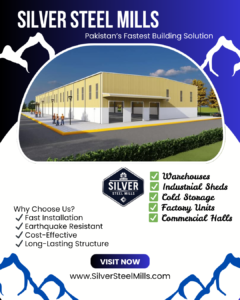
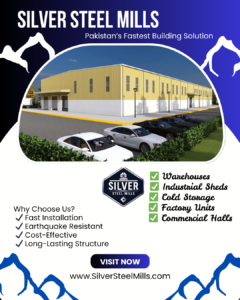


🛡️ Durable. Flexible. Cost-Effective.
Whether you’re building a warehouse in Karachi, a dairy shed in Sargodha, or a marquee in Lahore, Silver Steel Mills delivers PEB solutions built to last decades with minimal maintenance.
Email: info@silversteelmills.com
Website: www.silversteelmills.com


🌐 Related Keywords Covered in This Page:
-
Pre-engineered steel buildings in Pakistan
-
Steel shed price in Pakistan
-
PEB shed price in Pakistan
-
Prefabricated structures
-
Sandwich panel manufacturers in Pakistan
-
Steel building manufacturers
-
Steel fabrication company in Pakistan
🏗️ Advanced Technology in PEB by Silver Steel Mills
Silver Steel Mills integrates the latest steel construction technologies to ensure that every PEB structure is:
-
Earthquake-resistant
-
Wind load certified
-
Thermally insulated (optional)
-
Modular and expandable
Our steel fabrication is done using automated CNC lines, precision cutting machines, and international welding standards that guarantee dimensional accuracy and structural safety.


📊 Comparing PEB to Conventional Construction in Pakistan
| Feature | Pre-Engineered Building (PEB) | RCC / Brick Masonry |
|---|---|---|
| Construction Time | 30–45 Days | 120–180 Days |
| Foundation Load | Lightweight | Heavy |
| Cost per Sq Ft | Lower | Higher |
| Flexibility / Expansion | Highly Flexible | Limited |
| Material Wastage | Minimal | High |
| Labor Requirement | Low | High |
| Weather Resistance | High | Moderate |
Silver Steel Mills offers you a faster return on investment, which is why leading industries, investors, and institutions in Pakistan are switching to our PEB solutions.
🏢 Popular PEB Structures Offered by Silver Steel Mills
Here are some of the best-selling steel building types we manufacture:
-
Industrial Factory Sheds – Built to support cranes, heavy equipment, and wide spans.
-
Cold Storage Facilities – Temperature-controlled buildings with sandwich panels.
-
Warehouse Structures – Designed for bulk material handling and logistics.
-
Agricultural & Dairy Sheds – Rust-resistant and ventilated structures.
-
Steel Marquees – Long-span aesthetic halls for weddings and events.
-
Prefab Office Buildings – Quick to build, comfortable, and relocatable.
-
Readymade Homes – Affordable modular living with long life and lower cost.
🧩 Modular Add-Ons & Customizations
Silver Steel Mills allows extensive customization in:
-
Mezzanine floors
-
Ventilation & skylights
-
Rolling shutters & sliding doors
-
Canopies, fascias, gutters
-
Solar panel-ready roofing systems
-
Sandwich panel walls and roofs
-
Painting (Polyurethane, anti-rust)
We ensure the perfect fit for your unique building requirements, whether small or large.


🧾 Documentation, Engineering, and Delivery
With every PEB project, we provide:
-
Structural drawings
-
Foundation layouts
-
BOQs with detailed costing
-
Erection & installation plans
-
Load-bearing certificates (if required)
-
Installation team dispatch (if opted)
All documentation is compliant with Pakistan’s local municipal regulations and engineering codes.
🌟 Case Studies & Real-Life Projects
Silver Steel Mills has completed dozens of successful PEB projects across Pakistan:
-
Textile Factory – Faisalabad (30,000 sq. ft)
-
Marquee Hall – Lahore (15,000 sq. ft)
-
Cold Storage – Multan (insulated sandwich panels)
-
Warehouse – Karachi Port (steel truss roof span 80ft)
-
Dairy Farm Shed – Okara (PUF roof, ventilated side walls)
Each client received on-time delivery, cost control, and superior after-sales support.
🚚 Delivery & Installation Support – Nationwide
We provide PEB delivery all across Pakistan, including:
-
Punjab: Lahore, Faisalabad, Multan, Sargodha
-
Sindh: Karachi, Hyderabad
-
KPK: Peshawar, Mardan
-
Balochistan: Quetta, Hub
-
AJK & Gilgit: Muzaffarabad, Skardu
You can opt for supply-only, or supply + installation, where our experienced crew handles everything from erection to finishing.
🧰 Tools & Equipment Provided (Optional)
Clients can optionally purchase or request:
-
Portable welding machine
-
Cutting sets & grinders
-
Toolkits for fitting and anchoring
-
Scaffolding & safety equipment
This makes in-house maintenance or minor modifications easy post-installation.
📌 Frequently Asked Questions (FAQs)
Q: How long does a typical PEB building take to complete?
A: From design approval to delivery: 15–30 days. Installation: 7–20 days, depending on size.
Q: Are PEB buildings weather-resistant?
A: Yes, we use anti-rust coatings, insulated panels, and wind-load-verified designs.
Q: What type of maintenance is required?
A: Minimal – occasional washing, bolt tightening, and roof inspections.
Q: Can you relocate or extend a PEB?
A: Absolutely. PEBs are modular, so they can be moved or expanded with low effort.
💬 Customer Testimonials
“Silver Steel Mills helped us build our dairy shed within budget and before the deadline. Their team was very professional and responsive.”
— Mr. Imran Shahid, Okara
“Our warehouse was built in just 21 days with perfect finishing. Highly recommended.”
— Mrs. Zainab Iqbal, Karachi


📞 Ready to Build Your Pre-Engineered Building?
Contact Silver Steel Mills today for:
-
Free consultation
-
Free BOQ / Quotation
-
Sample designs
-
Site inspection (optional)
🌐 Website: www.silversteelmills.com
✅ Related Query
-
Pre-engineered buildings in Pakistan
-
PEB shed price in Pakistan
-
Steel shed manufacturer in Pakistan
-
Warehouse shed manufacturers in Pakistan
-
Prefabricated steel buildings
-
Sandwich panel price in Pakistan
-
Steel fabrication company in Pakistan
-
Pre engineered steel building manufacturers
Pre-Engineered Buildings (PEBs)
As the demand for modern, modular, and sustainable construction grows across Pakistan, Silver Steel Mills continuously evolves its engineering standards. Here’s how our PEB systems are enhanced through innovative building solutions:
🔸 1. Light Gauge Steel Construction in Pakistan
Light gauge steel framing is gaining popularity for:
-
Residential structures
-
Prefab offices
-
Educational buildings
At Silver Steel Mills, we use high-tensile steel sheets with corrosion-resistant coatings for safe and long-lasting performance.
Advantages:
-
Lightweight yet strong
-
Speedy on-site installation
-
Minimal waste and eco-friendly
🔸 2. Insulated Metal Buildings & Sandwich Panels
PEBs in Pakistan must withstand extreme heat and cold. Silver Steel Mills integrates sandwich panels with Rockwool, EPS, or Polyurethane Foam (PUF) insulation.
📌 Sandwich Panel Features:
-
Fire-resistant
-
Soundproof
-
Thermally insulated
-
Long-lasting (over 25 years)
Used in: Cold storage, dairy sheds, food factories, hospitals, prefab schools
👉 Related Keyword Focus:
-
Sandwich panel manufacturers in Pakistan
-
Insulated metal buildings
-
Sandwich panel price in Pakistan

🏗️ PEB Custom Structures by Sector
🐄 Dairy Shed Manufacturer in Pakistan
PEBs are perfect for livestock management, especially in high-temperature zones. Silver Steel Mills builds natural ventilated dairy sheds, ensuring comfort for animals and better milk yields.
🐄 Dairy Shed Benefits:
-
Low-cost roofing with insulation
-
Extended height for airflow
-
Sidewall panels for protection
-
Partition-ready designs for cow, buffalo, and feed zones
Relevant Keywords:
-
Dairy farm shed price in Pakistan
-
Dairy shed manufacturer in Pakistan
-
Dairy farm shed design in Pakistan
🏭 Industrial Shed Manufacturers in Pakistan
Silver Steel Mills is a trusted name for heavy-duty industrial sheds with wide-span columns and EOT crane-ready systems.
🏭 Industries We Serve:
-
Textile units
-
Garment & stitching factories
-
Steel re-rolling mills
-
Plastic molding units
-
Logistics & packaging companies
Keyword Focus:
-
Industrial shed manufacturers in Pakistan
-
Warehouse shed manufacturers in Pakistan
-
Steel shed price in Pakistan
🎪 Wedding Marquee Manufacturer in Pakistan
With the wedding industry booming in cities like Lahore, Faisalabad, and Karachi, Silver Steel Mills offers decor-friendly steel marquees that are durable, rust-free, and expandable.
Options Available:
-
A-frame & dome structures
-
Clear span widths up to 100 ft
-
Sliding doors and false ceiling support
-
Sandwich panel & tensile fabric roofing
Target Keywords:
-
Wedding marquee manufacturer in Pakistan
-
Steel structures in Pakistan
-
Steel shed manufacturer in Pakistan
🔧 Turnkey PEB Services by Silver Steel Mills
We don’t just sell steel—we deliver complete building solutions.
Our Turnkey Services Include:
-
Architectural planning
-
Structural drawing & load analysis
-
Civil foundation layout
-
Steel fabrication
-
On-site erection
-
Accessories: louvers, fans, gutters, cladding, skylights
You’ll receive a complete steel structure ready for interior finishing.
🔍 Additional Keywords and Topics You Can Target in Future Content
Here are more long-tail keyword topics to write articles or product pages on, all related to your PEB category:
| Keyword Topic | Suggested Article Title |
|---|---|
| Steel fabrication companies in Pakistan | “Top Steel Fabrication Companies in Pakistan for Industrial Projects” |
| Prefabricated steel structures | “Prefabricated Steel Structures – Versatile, Fast, and Economical” |
| Steel structure companies in Pakistan | “How to Choose the Best Steel Structure Company in Pakistan” |
| PEB companies in Lahore | “PEB Steel Structure Experts in Lahore – Silver Steel Mills” |
| Pre-fabricated warehouse in Pakistan | “Building a Warehouse with Prefabricated Structures in Pakistan” |
| Building steel price in Pakistan | “2025 Guide: Building Steel Price in Pakistan (Per Ton, Kg & Sq Ft)” |
| Pre-engineered steel home price | “Cost of Building a Pre-Engineered Steel Home in Pakistan” |
| Metal shed manufacturers | “Durable Metal Shed Manufacturers in Pakistan – Sheds for All Needs” |
| Corrugated metal sheds for sale | “Corrugated Metal Sheds for Farms and Industry in Pakistan” |
| Pre-engineered building design samples | “Download Free Pre-Engineered Steel Building Layouts and Designs” |
🏁 Final Thoughts: Why Silver Steel Mills is Pakistan’s No. 1 PEB Company
Silver Steel Mills combines:
-
Experience (since 2016)
-
Technical precision
-
Affordable rates
-
On-time delivery
-
100% Pakistani manufacturing
-
Responsive customer support
From designing to erection — whether it’s a mini dairy shed or a multi-acre industrial plant, we handle it all. Our clients span from small business owners to large real estate developers and government contractors.
📞 Get Started Today
Get in touch for a custom quote, design consultation, or site visit. We are ready to serve you across all cities of Pakistan.
🧱 Technical Excellence in PEB – Silver Steel Mills’ Commitment to International Standards
At Silver Steel Mills, our engineering team ensures that all Pre-Engineered Buildings meet or exceed global structural safety codes. Every project is fabricated with reference to:
-
ASTM International (American Society for Testing and Materials)
-
AISC (American Institute of Steel Construction)
-
MBMA (Metal Building Manufacturers Association)
-
BS EN ISO Standards (British & European norms where applicable)
We use finite element analysis (FEA) to optimize each component, minimizing weight and cost while ensuring seismic and wind resistance.
🧰 Core Structural Components in Silver Steel Mills’ PEB Systems
Each building is an assembly of the following engineered parts:
| Component | Description |
|---|---|
| Primary Framing | Rigid frames made from I-Beams using high-strength steel |
| Secondary Framing | Purlins, girts, eave struts to support walls and roofs |
| Roof & Wall Panels | Galvanized corrugated sheets or sandwich panels |
| Bracing System | Diagonal bracing (rod or cable) for lateral stability |
| Anchor Bolts | Embedded foundation bolts as per design load calculations |
| Accessories | Louvers, doors, windows, skylights, insulation, gutters |
Steel Grades Used: ASTM A36, ASTM A572 Grade 50, or equivalent
Welding Standard: AWS D1.1 Structural Welding Code
Galvanization: G90/Z275 (90 gsm zinc coating for anti-rust protection)
🛡️ Fire-Resistance & Safety Compliance
PEBs by Silver Steel Mills can be optionally equipped with fire-rated panels, fire doors, and sprinkler-ready ceiling supports. Our structures comply with Pakistan Building Code (PBC) and Fire Safety Act, including:
-
Flame retardant insulation
-
Roof-mounted smoke ventilation
-
Proper exit design & steel separation barriers
We also offer certification-ready structures for:
-
ISO 9001 projects
-
International donor-funded buildings
-
Government tenders (PKR, PSDP, CPEC related)
♻️ Green Construction – Sustainable & Eco-Friendly Steel Buildings
Pre-engineered buildings are among the greenest building methods available today.
-
90% of our steel is recyclable
-
Minimum material wastage
-
Insulation reduces energy costs up to 30%
-
Reusable structures (can be disassembled and relocated)
-
Solar panel compatibility for net-zero applications
PEBs qualify for LEED (Leadership in Energy and Environmental Design) and Green Star certifications when combined with sustainable planning.
📐 Structural Design Flexibility – Tailored to Your Industry
Silver Steel Mills supports custom architectural styling and functional designs across:
🏢 Commercial PEBs
-
Showrooms, banks, warehouses
-
Modern facades with ACP cladding or glass panels
-
Office partitions, HVAC-ready ceiling grids
🏭 Industrial PEBs
-
EOT crane support up to 20 tons
-
Clear spans up to 100 ft
-
Load-bearing mezzanines
🐄 Agricultural PEBs
-
Dairy sheds, poultry farms
-
Cross-ventilation frames
-
Side cladding with mesh openings
🏠 Residential & Readymade Homes
-
2-3 bedroom prefab villas
-
Sandwich panel roof and wall
-
Earthquake-resistant steel skeleton
📊 Detailed Project Costing
PEB pricing is calculated based on:
-
Building dimensions (length × width × height)
-
Material type (galvanized, sandwich panel, painted)
-
Roof style (gable, single slope, arch)
-
Accessories (doors, windows, insulation)
-
Location & accessibility
📌 All prices are approximate and vary with steel rates and market conditions.
🏗️ Design Options Offered by Silver Steel Mills
| Feature | Options Available |
|---|---|
| Roof Style | Gable, Arched, Single Slope |
| Roof Insulation | Rockwool, PU foam, Double sheet |
| Wall Finish | Sandwich panels, Brick cladding, Steel sheet |
| Doors | Sliding, Rolling shutter, Hinged steel doors |
| Windows | Aluminum, UPVC, Fixed, Louvers |
| Panel Color | Standard grey, Blue, Custom RAL codes |
🔩 Tools and Bolts We Use
-
Anchor bolts: High-tensile J-type bolts (ASTM A307 or better)
-
Fasteners: Galvanized self-drilling bolts with washers
-
Paint: Two-layer epoxy or polyurethane for anti-corrosion
-
Roof accessories: Ridge caps, flashing, drip trims, and silicon sealant
Every nut, bolt, and fitting is precision-engineered.
💡 Additional Features for PEB Projects
-
Solar panel-ready rooftops
-
False ceiling and air conditioning framework
-
Sound-insulated acoustic panels
-
Anti-condensation film for roofing
-
Stormwater drainage planning
📝 Project Documentation Provided
Each project includes a professional set of documents:
-
Architectural drawings (AutoCAD, PDF, hard copy)
-
Structural design report
-
Material certificates
-
Welding and inspection reports
-
BOQ (Bill of Quantities)
-
Electrical and plumbing framework (optional)
-
Maintenance manual
These documents ensure easy approvals from LDA, MDA, or municipal authorities.
📢 Recent and Ongoing Projects by Silver Steel Mills
| Project Type | Location | Size | Timeline |
|---|---|---|---|
| Warehouse | Lahore Dry Port | 25,000 sq.ft | 25 Days |
| Readymade Home | Islamabad Farmhouse | 1800 sq.ft | 20 Days |
| Dairy Shed | Okara | 12,000 sq.ft | 18 Days |
| Marquee Hall | Multan | 15,000 sq.ft | 22 Days |
Our teams deliver punctual project handovers, even during monsoon or off-season periods.
🎯 Why Silver Steel Mills is Pakistan’s Leading PEB Company
-
✅ Founded in 2016, 30+ staff, 100+ completed projects
-
✅ In-house design + fabrication + installation
-
✅ Trusted by clients in agriculture, industry, commerce
-
✅ Affordable, efficient, and future-ready building solutions
-
✅ Customer-first approach, ISO-aligned quality checks
📍 Contact Silver Steel Mills Today
Whether you’re building a warehouse in Karachi, a dairy shed in Sahiwal, or a prefab office in Islamabad, we’re ready to support your growth with top-tier steel structures.
Why Not All Metal Buildings Are the Same – The Silver Steel Mills Difference
Introduction: A Conversation About Quality
When you’re planning to build a factory, a warehouse, a dairy shed, or a marriage hall, you hear a lot of promises. Every contractor says their building is the best. Every manufacturer says their steel is strong. But the truth is – not all metal buildings are the same. Not even close.
I’ve been in this industry long enough to know that the difference shows up years after the building is up. It shows up when the roof starts leaking. When the panels fade. When the bolts loosen. When the insulation sags.
That’s why I want to talk to you today about what makes a pre‑engineered steel building truly superior. Not just the steel grade or the sheet gauge – but the engineering, the fastening systems, the roof design, the thermal performance, and the attention to detail that separates a building that lasts 30 years from one that starts giving you trouble in 5.
At Silver Steel Mills, we don’t just assemble steel. We manufacture, we engineer, and we build – using many of the same principles that the world’s best pre‑engineered building manufacturers have perfected over decades. And in this article, I’ll walk you through what those principles are, and why they matter for your project in Pakistan.
The Foundation: Engineering That Starts Before the First Cut
Most local fabricators will take your order, buy some steel from the market, cut it on site, and weld it together. That’s not engineering – that’s guesswork.
A proper pre‑engineered metal building starts with a research-backed design. In the global industry, the best manufacturers – like those who have been around for nearly a century – invest heavily in R&D. They test their components in real conditions. They measure wind loads, thermal expansion, fastener pull‑out strength, and corrosion resistance.
At Silver Steel Mills, we follow that same philosophy. Every building we design is calculated for:
-
Wind loads specific to your location (Karachi needs 150 km/h resistance; Punjab less)
-
Seismic zones (for KP, AJK, and northern areas)
-
Snow loads (for Murree, Swat, Gilgit)
-
Thermal movement (steel expands and contracts – we design for it)
We don’t guess. We use engineering software. We test our welds. We certify our steel grades (Q235B and Q345B). And we’ve learned from over 500 buildings across Pakistan – including CPEC motorway projects, DHA developments, and Nishat Power.
The Frame: Widespan vs. Long Bay – What Works in Pakistan
In the global industry, there are two common structural approaches: widespan systems and long bay systems.
Widespan is what most people think of as a standard metal building – main frames (columns and rafters) spaced every 5 to 8 meters, with purlins spanning between them. It’s strong, proven, and cost‑effective for most applications – dairy sheds, warehouses, marriage halls.
Long bay systems use a different structural member – sometimes a truss‑like joist – that allows you to space your main frames much farther apart, often 12 to 15 meters. This reduces the number of columns inside your building. For a factory or a large warehouse, fewer columns mean more usable floor space for machinery, racks, or vehicle movement.
At Silver Steel Mills, we design both. For a typical dairy shed or small warehouse, widespan with 6‑meter bay spacing is perfect – economical and strong. For a textile mill or a logistics hub where you need to move forklifts freely, we can engineer a long bay layout with wider spacing. The key is matching the system to your actual operation – not just selling a one‑size‑fits‑all structure.
The Bracing System: Rod vs. Cable – Why It Matters
One of the biggest hidden differences in metal buildings is the bracing. Bracing is what keeps your building square and stable against wind and seismic forces. You don’t see it – it’s inside the walls – but it’s critical.
Many cheaper suppliers use cable bracing. It’s easy to install and cheap. But cable stretches over time. It loosens. And once it’s loose, your building can sway, doors can stick, and panel seams can open.
The better solution – and what we use at Silver Steel Mills – is rod bracing. Solid steel rods, threaded at the ends, tightened with turnbuckles. Rods don’t stretch. They provide a much stronger, more rigid bracing system. Your building stays square for decades, not years.
We’ve seen too many buildings in Pakistan where cheap cable bracing has failed after a few monsoons or a mild tremor. We don’t compromise on this. Every Silver Steel Mills building gets rod bracing as standard.
The Paint Finish: Kynar vs. Polyester – What Lasts in Pakistani Sun
Pakistan’s sun is brutal. UV radiation, extreme heat, and dust can destroy a cheap paint finish in a few years. Once the paint goes, rust follows.
In the global industry, there are two common paint systems for steel panels:
-
Silicone polyester – cheaper, less UV resistant, fades and chalks after 5‑7 years.
-
Kynar (PVDF) – premium finish, highly UV resistant, holds color and gloss for 20+ years.
Many local suppliers use silicone polyester or even just enamel paint. It looks good on day one. But after two hot summers, it starts fading. After five years, you’re repainting or replacing panels.
At Silver Steel Mills, we offer PPGI sheets with high‑durability paint systems. For critical projects or buildings in very sunny areas (like Sindh or South Punjab), we recommend Kynar‑equivalent finishes. We’ve seen PPGI sheets last 15‑20 years without significant fading when properly specified. That’s the kind of longevity you should expect.
Pre‑Punching: The Erector Set Advantage
Remember playing with an erector set as a kid? Every hole was already there. You couldn’t put a bolt in the wrong place. When you finished, the structure was plumb, level, and square.
That’s exactly what pre‑punching does for metal buildings. Instead of drilling holes on site (where things can go wrong), the purlins, girts, and columns are punched at the factory to exact modular dimensions. Every hole lines up. Every connection fits perfectly.
What does this mean for you?
-
Faster erection – no time wasted measuring and drilling.
-
Stronger connections – we use screw bolts (grade 8.8) instead of self‑drilling screws, which are weaker.
-
Better alignment – straight walls, straight rooflines, no surprises.
Most local fabricators don’t pre‑punch. They drill on site, and mistakes happen. Your building ends up slightly crooked, doors don’t close properly, panels don’t align. At Silver Steel Mills, we pre‑punch every purlin and girt. It’s one of the reasons our buildings go up faster and stay straight longer.
The Fasteners: Small Part, Huge Difference
Look closely at a cheap metal building, and you’ll see small, skinny self‑drilling screws. They’re fine for light applications, but for a large industrial building? Not enough.
The difference is in the size and type of fastener. At Silver Steel Mills, we use high‑tensile grade 8.8 bolts for all structural connections – columns, rafters, and bracing. For panel attachment, we use heavy‑gauge self‑drilling screws with large washers and corrosion‑resistant coating.
In fact, the pull‑out strength of our fastener system is significantly higher than what many competitors use. That means your roof panels stay attached even during high winds. Your wall panels don’t rattle loose. Your building holds together.
And for critical roof connections, we use lock nuts and factory‑welded studs on splice plates – the same method used by top global manufacturers. This ensures that splices don’t loosen over time, which is a common source of leaks and structural weakness.
The Roof System: Standing Seam vs. Screw‑Down – A Game Changer
If there’s one part of a metal building that fails most often, it’s the roof. Leaks, blown‑off panels, rust at fastener holes – these are the top complaints.
The traditional method is screw‑down panels. You screw the panel directly to the purlin, with exposed fasteners. Every single screw is a potential leak point. Over time, the neoprene washer dries out, the screw backs out slightly, and water finds its way in.
A superior solution is the standing seam concealed fastener roof system. This is what the best global manufacturers use – and what we offer at Silver Steel Mills for clients who want the highest level of protection.
How does it work? Panels are mechanically seamed together using a Pittsburgh 360° seam – the same type of seam used on the top of a pop can. That seam is watertight. There are no exposed fasteners on the flat part of the roof. The clips that attach the panel to the purlin are hidden inside the seam, and they allow the roof to expand and contract with temperature changes – which steel does, quite a bit.
In a screw‑down system, thermal expansion can cause panels to buckle or fasteners to tear. In a standing seam system, the roof can move freely while remaining watertight.
We also use a seamed rake trim – meaning the edge of the roof is seamed, not screwed down. Competitors often screw the rake trim through the panel, creating more leak points. We eliminate that.
And for roof laps (where two panels need to be spliced because the building is very long), we place the lap directly over a purlin, use a heavy backplate with factory‑welded studs, and secure it with lock nuts. This is much stronger and more reliable than the typical method of lapping between purlins and relying on self‑drilling screws.
If you’re building a cold storage, a warehouse for expensive goods, or any facility where a roof leak would be disastrous, you should seriously consider a standing seam roof system. Yes, it costs more upfront. But the savings in avoided repairs and product damage make it worth it.
Thermal Performance: Insulation That Actually Works
Energy costs in Pakistan are high and rising. A poorly insulated metal building will cook you in summer and freeze you in winter – and your electricity bill will reflect that.
The challenge is that standard insulation (just a layer of fiberglass over the purlins) gets compressed when the roof panels are screwed down. Compression reduces its R‑value dramatically.
Better systems use raised clips to create space for thicker insulation. At Silver Steel Mills, we offer three clip heights – standard, tall, and extra‑tall. With the extra‑tall clip, we can fit up to 9.25 inches of insulation, achieving approximately R‑30 for the roof system. That’s real energy efficiency.
We also offer a TBS (thermal break system) where we put insulation over the purlins, then a secondary sub‑purlin, then another layer of insulation, then the roof panels. This virtually eliminates thermal bridging through the fasteners.
And for walls, we have an e‑shadow wall system that uses thermal blocks between the panel and the girt, creating a continuous thermal break. This significantly improves the wall insulation performance, keeping your interior comfortable and your energy bills low.
We don’t guess at R‑values. We use hot‑box testing principles – similar to what global research labs do – to calculate exactly what performance you’ll get. So when we tell you that a certain insulation package will achieve R‑25, we can back it up.
Curbs, Penetrations, and Details – The Devil Is in the Details
Every roof needs penetrations – for HVAC units, exhaust fans, skylights, or vents. Every penetration is a potential leak. But the difference is in how you manage them.
At Silver Steel Mills, we provide curbs specifically designed for our roof system. Generic curbs don’t always seal properly against a standing seam panel. Our curbs integrate with the seam profile, and we use proper flashing and sealing details to maintain the roof’s integrity.
We also advise clients to minimize roof penetrations. Whenever possible, mount equipment on the ground or on a separate mezzanine. Less holes = less problems.
Why This Matters for Your Project in Pakistan
You might be thinking – this all sounds great, but is it practical for my budget? I understand. Every rupee counts.
Here’s what I’ve learned from hundreds of projects across Pakistan: cheaping out on the details costs you more in the long run.
A building with cable bracing instead of rod bracing might save you 1% upfront. But when it loosens after a few years and your doors start jamming, you’ll pay more in repairs and lost productivity.
A screw‑down roof might save you 5% compared to a standing seam. But when it leaks during the first monsoon and damages your inventory, that saving disappears.
A cheap paint finish might look fine for two years. But when it fades and rust starts at year three, you’ll be repainting or replacing panels – at a much higher cost.
At Silver Steel Mills, we don’t force everyone into the most expensive option. We explain the trade‑offs. We help you choose what makes sense for your budget and your risk tolerance. But we also refuse to cut corners that we know will fail.
We’ve built dairy sheds in Sahiwal with simple open GI roofs – because that’s what the farmer needed, and it works. We’ve built cold storages in Lahore with PU panels and standing seam roofs – because that’s what the food distributor required. We tailor the system to the application.
But the underlying principles – proper bracing, quality fasteners, pre‑punching, thermal design – apply to all buildings, large or small.
Real Projects, Real Results
I don’t need to sell you on theory. Let me give you a few examples of what this approach has delivered in Pakistan.
CPEC Motorway (CSCEC) – We supplied multiple SSM 18 block plants and also engineered steel structures for site offices and storage sheds. The Chinese contractors were impressed with our quality and precision.
Nishat Power, Lahore – We installed a fly ash brick plant (SSM 15) that turns 35 tons of daily waste into 10,000 bricks. The building itself needed to handle heavy vibration and dust – we designed a robust steel frame with proper bracing and durable cladding.
DHA Lahore Phase 8 – We delivered an SSM 15 block making plant, and also supplied pre‑engineered steel buildings for commercial plots. The developers insisted on quality because DHA has strict standards.
Gulberg Greens, Islamabad – A 3,000 sqft marriage hall built in 28 days with clear span and insulated roof. The client saved over 25 lakh compared to civil construction and got a better building.
Abbottabad Motorway – We installed an SSM 18 plant to produce curbstones locally. Before that, they were bringing curbstones from Islamabad – expensive and slow. Our client saved millions and finished the project on time.
In every case, the buildings we supplied have stood up to Pakistan’s climate, daily use, and heavy operational loads. Not because we used expensive materials unnecessarily – but because we paid attention to the details that matter.
Pre-Engineered Buildings (PEB) Mein “The Quality Difference”: Kyun Har Steel Shed Aik Jaisa Nahi Hota?
Jab aap Pakistan mein apni factory, warehouse, ya rice mill ke liye pre-engineered steel shed banane ka faisla karte hain, toh market mein aapko darjanon vendors milenge. Sab ka daawa hota hai ke woh sab se sasta aur behtareen structure bana kar dein ge. Magar haqeeqat yeh hai ke har metal building aik jaisi nahi hoti.
Tameerati dunya mein aik bohot badi misaal hai—jaise dunya bhar mein Butler Manufacturing ne steel structures mein apni research aur quality ki wajah se aik alag maqaam banaya hai, bilkul waise hi Pakistan ke industrial sector mein Silver Steel Mills (SSM) ne high-end engineering aur fabrication standards ke zariye aik bada farq paida kiya hai.
Chalein aaj bilkul saaf aur aam bol-chal mein samajhte hain ke aik aam steel shed aur aik high-quality advanced pre-engineered building (PEB) mein asli farq kahan aata hai, aur aapko apna paisa kahan invest karna chahiye.
1. Widespan System Vs Landmark System: Column-Free Space Ka Asli Sach
Aam tor par metal buildings do tarah ke structural designs par banti hain:
-
Standard Widespan System: Isme building ke mainframes aur purlins ka istemal hota hai. Yeh un setups ke liye behtareen hai jahan darmiyan mein columns (pillaers) se koi masala na ho.
-
Long Bay / Landmark System: Is system mein bar-joist ya truss purlins ka istemal kiya jata hai. Iska sab se bada faida yeh hota hai ke yeh imarat ke andar se faaltu columns ko bilkul khatam ya kam kar deta hai.
Faida Kya Hota Hai? Jab aapke factory hall ya warehouse ke andar darmiyan mein pillaers nahi hon ge, toh aapko warehousing, heavy machinery layout, aur forklift ki movement ke liye aik khulla aur behtareen space milega. Silver Steel Mills aapke operation ke layout ke mutabiq yeh customized long-bay designs khud ready karti hai.
2. Pre-Punching Technology: Erector Set Jaisi Precision
Kya aapne bachpan mein kabhi woh khilonay wale “Erector Sets” ya jor-tod wale blocks khele hain? Unme har patti aur frame mein pehle se holes (surakh) bane hote the. Aap sirf unhi holes mein bolt daal kar cheezein jor sakte the, jiske nateejay mein jo imarat ya khilona banta tha, woh bilkul seedha aur level mein hota tha.
High-quality PEB structures mein bilkul yahi formula apply hota hai:
-
Pre-Punched Purlins & Girts: Silver Steel Mills apni automatic factory mein CNC machinery ke zariye saare steel members, girts, aur purlins ko pehle se punch (holes) kar ke site par bhejti hai.
-
Plumb & Level Structures: Site par ja kar labor apni marzi se kahin bhi surakh nahi kar sakti. Unhein sirf pehle se maujood holes ko bolting ke zariye fit karna hota hai. Is se poori building bilkul plumb (90-degree perfectly seedhi) aur level mein khari hoti hai.
-
Screw Bolts Ka Istemal: Pre-punching ka sab se bada faida yeh hai ke isme heavy screw bolts lagaye jate hain, jo un self-drilling ya tap-screws se kahin zyada mazboot hote hain jo aam competitors jaldi-jaldi mein use karte hain.
3. Rod Bracing Vs Cheap Cable Bracing
Building ko andhi, tufan, aur zalzale ke jhatkon se bachane ke liye “bracing system” sab se ahem role play karta hai.
-
Cheap Cable Bracing: Market mein bohot se local vendors paise bachane ke liye patli cables (taaron) ka bracing system laga dete hain. Yeh waqt ke sath dheeli ho jati hain aur tez hawa mein poora shed hilne lagta hai.
-
Solid Rod Bracing: SSM strictly wall aur roof bracing ke liye heavy solid Steel Rods ka istemal karta hai. Yeh aik bohot hi mazboot structural member hai jo imarat ke pooray dainche ko har tarah ke dynamic load aur sakht mausam mein apni jagah se hilne nahi deta.
4. Paint Finish: Kynar Coat Vs Local Silicone Polyester
Pakistan ke sakht mausam aur industrial areas mein dhuwan aur chemicals ki wajah se steel sheets ka rang urr jana ya un par zang (rust) lag jana ek aam masala hai.
-
Aam vendors sheets par sasta Silicone Polyester finish use karte hain, jo do-teen saal mein hi kharab hone lagta hai.
-
Premium PEB structures mein sirf Kynar Finish (PVDF coating) ka istemal kiya jata hai. Yeh dunya ka sab se aala quality ka paint finish hai jo UV rays, high temperature, aur chemical weathering ke khilaf deewar aur chat ke panels ko saalon saal naya jaisa rakhta hai.
5. Leak-Proof Roof System: Pittsburgh Seaming Aur Solid Splices
Kisi bhi factory owner ke liye sab se bada sir-dard chat ka tapakna (roof leaks) hota hai. Aik dafa chat mein leak ho jaye, toh andar pari lakhon rupe ke raw material aur machinery kharab ho jati hai. Is masale ka hal high-end roof engineering mein chhupa hai:
-
Concealed Fastener & Mechanical Seaming: Chat ke panels ko jorne ke liye bahar se screw lagane ke bajaye mechanical seamer ke zariye Pittsburgh 360 Seam di jati hai (bilkul waise hi jaise aik cold-drink ke can ke upar ka dhoona water-tight sealed hota hai). Isme koi fastener chat ke upar nanga nahi rehta, jisse paani andar aane ka rasta hi khatam ho jata hai.
-
Solid Lap Splices Over Purlins: Jab building lambi ho aur do roof panels ko aapas mein jorna (splice) paray, toh aam vendors purlin se door hawa mein hi panels ko jor dete hain. Jab koi labor us par charta hai, toh rib dab jati hai aur leak sharu ho jata hai. Premium engineering mein yeh splice directly purlin ke upar solid backing plate aur factory-welded studs ke sath ki jaati hai, jo hamesha ke liye tight rehti hai.
6. Roof Curbs Aur Energy Efficiency (TBS System)
Factory ke andar ventilation ke liye exhaust fans ya HVAC units lagane parte hain, jiske liye chat mein surakh (penetrations) karne parte hain. Agar curbs generic hon ge, toh leaks lazmi hain. Silver Steel Mills customized, fully-integrated roof curbs design karti hai jo chat ke design ke sath completely seal ho jate hain.
Sath hi, aaj kal energy costs (bijli ke bill) bohot barh chuke hain. Iske liye Thermal Block System (TBS) aur extra-tall clips ka istemal kiya jata hai jo girts aur panels ke darmiyan aik continuous thermal break paida karte hain. Is se insulation ko phelne ka poora space milta hai aur factory ke andar ka temperature maintain rehta hai, jis se cooling expenses bohot hadd tak kam ho jate hain.
Technical Performance Evaluation: High-Quality PEB Vs Ordinary Steel Sheds
| Structural Component | Premium Pre-Engineered Buildings (SSM Style) | Ordinary Local Steel Sheds |
| Fabrication Method | Pre-punched modular components (Zero error) | On-site manual drilling and welding |
| Wall & Roof Paint | High-Grade Kynar Finish (Anti-fading) | Standard Silicone Polyester / Local paint |
| Structural Bracing | Heavy Solid Steel Rods | Light/Cheap Cable wire bracing |
| Fasteners & Rivets | Oversized heavy-duty rivets (High pull-out force) | Small standard self-tapping screws |
| Roof Seaming | 360-Degree Mechanical Seaming (Leak-proof) | Overlapping sheets with external exposed screws |
| Thermal Protection | Advanced Thermal Block System (TBS) | Single layer sheets without continuous thermal break |
Kyun Silver Steel Mills Aap Ka Behtareen Partner Hai?
Pre-engineered building lagana sirf steel khara karne ka naam nahi hai, balki yeh aik proper science hai. Silver Steel Mills (SSM) ke heavy-duty designs poori tarah se load-tested aur structural engineering ke standards par poora utarte hain. Hum har structural member, girt, aur rivet ko zero-error precision ke sath tayar karte hain taake aapki factory ka roof aur wall system century tak mahfooz rahe.
Apni factory, warehouse, ya commercial plant ke liye premium standard engineering aur competitive structural pricing haasil karne ke liye aaj hi hamari engineering desk se rabta karein:
Showing all 15 results
-

Commercial Container price in Pakistan
Read more -
Sale!

Light gauge steel construction in pakistan
Original price was: ₨670.₨600Current price is: ₨600. Add to cart -
Sale!

PEB Building Price in Pakistan
Original price was: ₨690.₨650Current price is: ₨650. Add to cart -
Sale!

PEB Shed Price in Pakistan: Complete Guide for 2025 | Silver Steel Mills
Original price was: ₨660.₨650Current price is: ₨650. Add to cart -
Sale!

Pre Engineered Steel Building Manufacturers in Pakistan – Silver Steel Mills
Original price was: ₨650.₨649Current price is: ₨649. Add to cart -
Sale!

Pre fabrication shed in pakistan
Original price was: ₨800.₨750Current price is: ₨750. Add to cart -
Sale!

Pre-Engineered Buildings (PEBs) in Pakistan
Original price was: ₨880.₨660Current price is: ₨660. Add to cart -
Sale!

Pre-Engineered Steel Buildings in Pakistan
Original price was: ₨800.₨700Current price is: ₨700. Add to cart -
Sale!

Prefab Buildings in Pakistan – Silver Steel Mills
Original price was: ₨650.₨600Current price is: ₨600. Add to cart -
Sale!

Prefabricated Industrial Shed Manufacturers in Pakistan
Original price was: ₨850.₨750Current price is: ₨750. Add to cart -
Sale!

Prefabricated Steel Structures in Pakistan
Original price was: ₨700.₨650Current price is: ₨650. Add to cart -
Sale!

Prefabricated Steel Structures in Pakistan – Ultimate Guide 2025 | Silver Steel Mills
Original price was: ₨770.₨660Current price is: ₨660. Add to cart -
Sale!

Readymade Homes in Pakistan: Affordable, Modern, and Durable Living Solutions
Original price was: ₨750.₨650Current price is: ₨650. Add to cart -
Sale!

Steel fabrication companies in pakistan
Original price was: ₨800.₨670Current price is: ₨670. Add to cart -
Sale!

Steel Structure Buildings in Pakistan
Original price was: ₨760.₨650Current price is: ₨650. Add to cart